Making friends as an adult is hard at 20 or 40. How to find your people after college or as an empty nester, one group at a time.
Erin Treacy
November 10, 2026
Finding your people takes more than one visit, at any age.
Making friends as an adult is hard, whether you’re 25 or 45. I learned it twice in the same season of life, once watching my daughter and once on my own. For both of us, the answer came down to one habit: pick a group and keep showing up.
After college, my daughter moved to another state where she didn’t know a soul. Work kept her busy, and she slowly learned her way around a new city. Friends were another story. She’s the youngest person at her job and not the type to walk up to a stranger and start a conversation. Small talk in the checkout line? Not happening.
Around the same time, I became an empty nester. For years, my closest friends had been the parents of my kids’ friends. We sat on the same bleachers and drove the same carpools. Once the kids grew up and moved out, the circle quietly faded.
So there we were, her in her 20s and me in my 40s, in the same boat.
Pick a group and keep showing up.
~ Erin Treacy
Why Making Friends as an Adult Feels So Hard
Growing up, friends just appeared. Class, clubs, teams and youth groups put the same faces in front of you every week. Nobody had to plan a thing.
Sociologist Rebecca Adams of the University of North Carolina at Greensboro explained the difference to The New York Times. Close friendships, she said, grow from three conditions: proximity, repeated unplanned interactions and a setting where people feel safe enough to open up. College delivers all three at once, which is why so many lifelong friendships start there. After graduation, you have to go looking.
A job might seem like a fill-in. You see some of the same people every day, but they work different shifts, live different lives and head home to different worlds.
Young adults feel the gap most. In Gallup’s global study on social connection, 27% of adults ages 19 to 29 said they felt very or fairly lonely. Among adults 65 and older, the share was 17%.
How to Find Your People After College or After the Kids Leave
My daughter and I ended up taking the same approach from two different states. We looked for new circles on purpose, and once we chose them, we stopped making excuses not to go.
One or two groups is plenty
Finding friends doesn’t mean filling every night with a social event. Choose one or two groups built around something you enjoy. My daughter found her people through church groups. For me, it was a few women’s groups close to home. Your fit might be a workout class, a book club, a volunteer crew or an adult sports team.
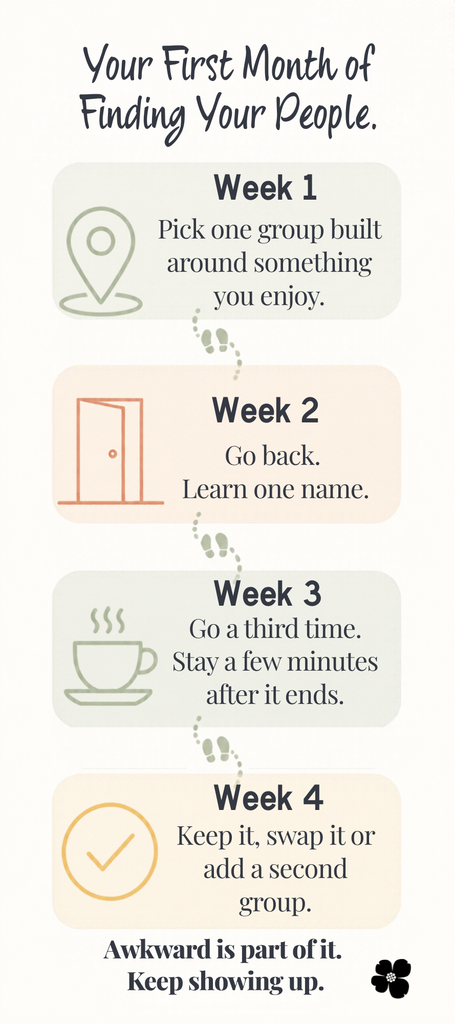
Give each group three visits
Walking in the first time felt weird. The second and third visits did too. Each one still brought a new name, a new face and a new story. After a few tries, you’ll know whether a group fits.
Each one still brought a new name, a new face, and a new story.
Give a new group a month before you decide.
Forget the headcount
I didn’t walk in with a number of people to meet. These weren’t networking events where you collect business cards and leave with a few leads. My goal was to get to know people and really connect with them.
The maybe is worth a try
Hear about something you aren’t sure of? Try it anyway, because you never know who you’ll meet. Gen Z even has a name for showing up somewhere again and again: “regularmaxxing,” or becoming a regular. Your grandparents had the corner diner. Same idea, new name. Author Chris Duffy told Time going to the same coffee shop day after day is how you get to know the staff and the other regulars.
What if you’re not outgoing?
My daughter still won’t strike up a chat at the grocery store, and she didn’t need to. A group gives quieter people a reason to be in the room and something to talk about once they arrive. Stepping out of your comfort zone still matters. You just get to do it alongside people who share your interests.
What Leaders Can Do for Young Employees
Many young employees moved for the job. Your office may be the only place in town where they see familiar faces every week.
Your office may be the only place in town where they see familiar faces every week.
Small moves help. Introduce new hires to people outside their department. Hold team lunches or events during the workday, so connecting doesn’t become one more thing to schedule after hours. When someone mentions a new class or group, ask how it’s going. Young employees want meaning and growth at work, and a few friendly faces make both easier to find.
Making Friends as an Adult Starts With Showing Up
Neither of us found our people overnight. We found them by picking a place and going back, even when it felt awkward.
Starting over in a new city, a new job or a suddenly quiet house? Choose one group this month and go three times before you judge it.
Adult life removes what school gave you for free: seeing the same people often, unplanned time together and a setting where people open up. Work and busy schedules rarely provide all three, so friendships have to be built on purpose through groups and routines you choose.
How long does it take to make friends as an adult?
Longer than in school, and it’s normal. Give any new group at least three visits before deciding whether it fits. Each time, you’ll meet someone new and feel a little less awkward. Steady, repeated time together matters more than one big night out.
How do I find my people after college if I’m an introvert?
Skip the pressure to talk to strangers in line. Join a group built around something you enjoy, like a church group, a workout class or a book club. The shared activity gives you a reason to be there and something easy to talk about.
How do empty nesters make new friends?
When the kids leave, the built-in circle of other parents often goes with them. Look for groups tied to who you are now, such as a women’s or men’s group, a volunteer organization or a fitness class. Commit to a few visits before deciding, even when walking in alone feels strange.
Frequently Asked Questions
Who is Erin Treacy Coaching for?
If your day already feels out of control before your feet hit the floor in the morning, you are likely the kind of person I work with.
You may be a business owner, leader, manager, or professional carrying too much, fixing too much, and feeling like too much depends on you. Erin Treacy Coaching is for people who believe in a people first way of leading and living, and who want stronger communication, better accountability, healthier systems, and a more productive and meaningful life.
This work is for people who are tired of constant reaction and ready for a better way forward.
How do I know if coaching is the right fit for me?
Coaching is a strong fit when work feels heavier than it should and you know something has to change. Most people reach out when they are tired of carrying too much, fixing the same problems over and over, or feeling like the business cannot move without them.
You may be the bottleneck in your organization. Your team may not be showing up the way you need them to. Performance may feel inconsistent. Communication may break down too often. You may spend more time reacting than leading. By the time the day starts, you already feel behind.
Coaching creates space to slow the frenzy, see what is really driving the problem, and build a better way forward. Sometimes the issue is not the people. It is how the work, expectations, and communication are set up around them. Coaching gives you a clearer view of what is happening, what needs to change, and how to move from constant reaction to steadier leadership.
What is the difference between people first coaching and servant leadership?
Servant leadership focuses on how a leader shows up for the people around them. It is about listening, supporting, building trust, and leading with care.
People first coaching includes those values, but it goes further. It also looks at how the business or team is set up for people to succeed. That means roles, expectations, communication, training, accountability, and everyday systems.
In other words, servant leadership often focuses on the heart of the leader. People first coaching looks at both the leader and the environment around the team. A leader can care deeply about people and still have a workplace full of confusion, inconsistency, and stress. People first coaching works to align leadership, structure, and culture so people can perform well without everything depending on one person holding it all together.
Do you work with individuals, teams, or both?
Both. Erin works with individuals in one to one coaching and also supports teams through
workshops, leadership development, and workplace training.
Can coaching improve communication, accountability, and team performance?
Yes. Many workplace problems are not caused by a lack of effort. They come from unclear
expectations, weak communication, and pressure people have not been taught to manage well.
Coaching focuses on building the habits and conversations that create steadier performance
and stronger trust.
Can coaching support burnout, overwhelm, or unclear priorities at work?
Yes. Coaching can support people who feel stretched thin, overwhelmed, or stuck in constant
reaction mode. The goal is not to push harder. The goal is to create clarity, better decisions,
stronger communication, and work habits people can sustain.
What happens in a clarity conversation?
A clarity conversation is a safe place to talk honestly about what the frenzy looks like in your work or life right now. This is not a sales call. It is a starting point.
We slow things down, look at what feels out of control, and begin to understand what is really driving the stress, pressure, or frustration. You do not need to come in with polished answers.
The goal is clarity, understanding, and a better sense of what kind of support makes sense from here.
Leave a Reply
About Erin Treacy
Erin Treacy is a leadership coach and consultant specializing in people-first approaches to professional development. With over 15 years of experience, she helps leaders and organizations build cultures where people thrive and businesses succeed.
If you enjoy the content, we’d love for you to share it with a friend!