Gen Z isn’t lazy, they want meaning and growth

Gen Z isn't lazy, they want meaning and growth top of page Home About Types of Coaching Leadership & Management Coachin Performance & Productivity Coa...

Erin Treacy

April 30, 2026

Walk into any workplace today and you’ll likely find a mix of four generations sharing the same space, screens, and goals. Each brings a story shaped by its time. Baby Boomers are anchored in loyalty, Gen X is built on independence, Millennials are wired for collaboration, and Gen Z, the newest wave, is motivated by meaning and growth.

Here’s the truth: Gen Z is not allergic to work. They’re allergic to meaningless work.

They want to know why their effort matters. They want to see where their energy leads. They crave growth and real feedback, not recycled notes.
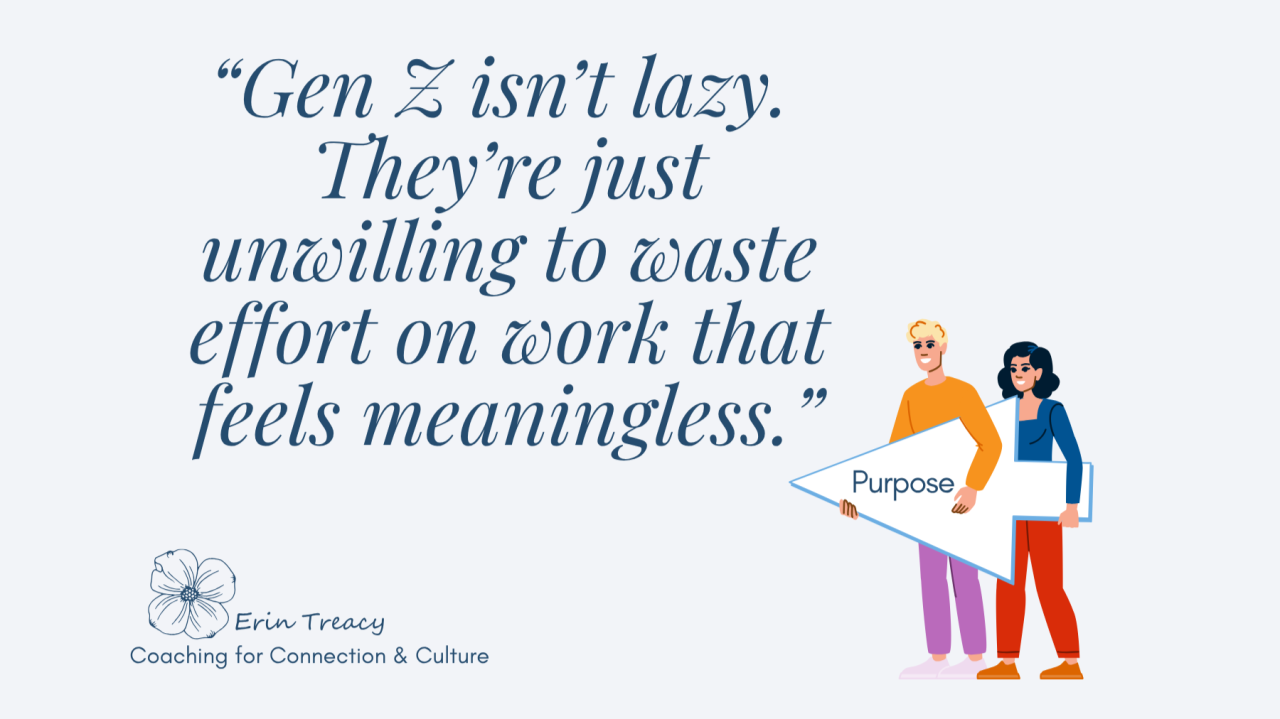
Gen Z is is motivated by purpose not pressure. Connect the work to meaning and Gen Z will jump in.

A Different Starting Line

Most Gen Z employees entered the workforce during years of global disruption and digital overload. They’re the most educated, most connected, and most cause driven generation in history. Yet they also carry the highest rates of workplace anxiety and disengagement when their jobs feel disconnected from purpose.

A 2024 Deloitte survey found 42 percent of Gen Z workers have turned down jobs because they didn’t align with their values. Gallup reports only 35 percent of Gen Z employees feel engaged at work.

Engagement, though, isn’t about perks, it’s about connection. When leaders take time to explain why a project matters and connect daily work to a larger mission, Gen Z responds with creativity and energy.

Small Questions with Big Impact

One of the simplest ways to build real connection is also the most overlooked…asking.

Start with a question like, “What do you want to learn here?”

It tells a young employee you see them as a learner, not a laborer. It also gives you insight into their curiosity which is something you can nurture. When people see a path, even a small one, they find meaning in each step.

Gen Z isn’t lazy they value speed, authenticity, and digital fluency, but their emotional driver is transparency. They don’t expect leaders to have all the answers, they expect them to be honest and human.

Bridge the Gap with EQ

Emotional Intelligence (EQ) is the bridge between intention and understanding. When you pause to listen, reflect back what you hear, and explain the why behind the what, then you’re speaking the language of connection.

A Boomer manager might say, “Let’s stick to what works.”A Gen Z employee might reply, “Let’s try something new.”

Both want success, they just define it differently. EQ helps translate those styles into a shared purpose.

As you model curiosity, transparency, and empathy, you’ll find this generation mirrors it back and then the culture begins to shift.

Gen Z isn’t lazy they are showing us a different way…and they are right.

Gen Z is reminding us of something every generation needs: work is not just a paycheck, it’s a place to grow. Leaders who connect the dots between meaning and growth won’t just retain Gen Z, they’ll re-energize everyone on the team.

Gen Z is changing how we all look at work. If you’re ready to turn connection into retention, let’s create a plan that fits your team.

💡 To learn more on how you can start building a team motivated by purpose, not pressure Book your first 1:1 session with Erin free today at calendly

Empowering People. Elevating Business.

Frequently Asked Questions

If your day already feels out of control before your feet hit the floor in the morning, you are likely the kind of person I work with.

You may be a business owner, leader, manager, or professional carrying too much, fixing too much, and feeling like too much depends on you. Erin Treacy Coaching is for people who believe in a people first way of leading and living, and who want stronger communication, better accountability, healthier systems, and a more productive and meaningful life.

This work is for people who are tired of constant reaction and ready for a better way forward.

Coaching is a strong fit when work feels heavier than it should and you know something has to change. Most people reach out when they are tired of carrying too much, fixing the same problems over and over, or feeling like the business cannot move without them.

You may be the bottleneck in your organization. Your team may not be showing up the way you need them to. Performance may feel inconsistent. Communication may break down too often. You may spend more time reacting than leading. By the time the day starts, you already feel behind.

Coaching creates space to slow the frenzy, see what is really driving the problem, and build a better way forward. Sometimes the issue is not the people. It is how the work, expectations, and communication are set up around them. Coaching gives you a clearer view of what is happening, what needs to change, and how to move from constant reaction to steadier leadership.

Servant leadership focuses on how a leader shows up for the people around them. It is about listening, supporting, building trust, and leading with care.

People first coaching includes those values, but it goes further. It also looks at how the business or team is set up for people to succeed. That means roles, expectations, communication, training, accountability, and everyday systems.

In other words, servant leadership often focuses on the heart of the leader. People first coaching looks at both the leader and the environment around the team. A leader can care deeply about people and still have a workplace full of confusion, inconsistency, and stress. People first coaching works to align leadership, structure, and culture so people can perform well without everything depending on one person holding it all together.

Both. Erin works with individuals in one to one coaching and also supports teams through workshops, leadership development, and workplace training.
Yes. Many workplace problems are not caused by a lack of effort. They come from unclear expectations, weak communication, and pressure people have not been taught to manage well. Coaching focuses on building the habits and conversations that create steadier performance and stronger trust.
Yes. Coaching can support people who feel stretched thin, overwhelmed, or stuck in constant reaction mode. The goal is not to push harder. The goal is to create clarity, better decisions, stronger communication, and work habits people can sustain.

A clarity conversation is a safe place to talk honestly about what the frenzy looks like in your work or life right now. This is not a sales call. It is a starting point.

We slow things down, look at what feels out of control, and begin to understand what is really driving the stress, pressure, or frustration. You do not need to come in with polished answers.

The goal is clarity, understanding, and a better sense of what kind of support makes sense from here.

About Erin Treacy

Erin Treacy is a leadership coach and consultant specializing in people-first approaches to professional development. With over 15 years of experience, she helps leaders and organizations build cultures where people thrive and businesses succeed.

If you enjoy the content, we’d love for you to share it with a friend!

INSIGHT

Recent Posts

Overfunctioning: The Weight You Don’t Notice Until You Set It Down

Overfunctioning creeps up slowly. Recognize the invisible weight of carrying too much and find small

Parenting a Young Adult: College Move In Advice for Parents

College move in brings excitement, pride and a new parenting role. Practical advice on letting

Busy Is the New Fine: Why Leading Your Life Is Actually Just Adulting

Leadership is adulting. We fill our calendars with supposed-to-dos to prove we're important, but a