

Four generations. Different definitions. Shared workplace.
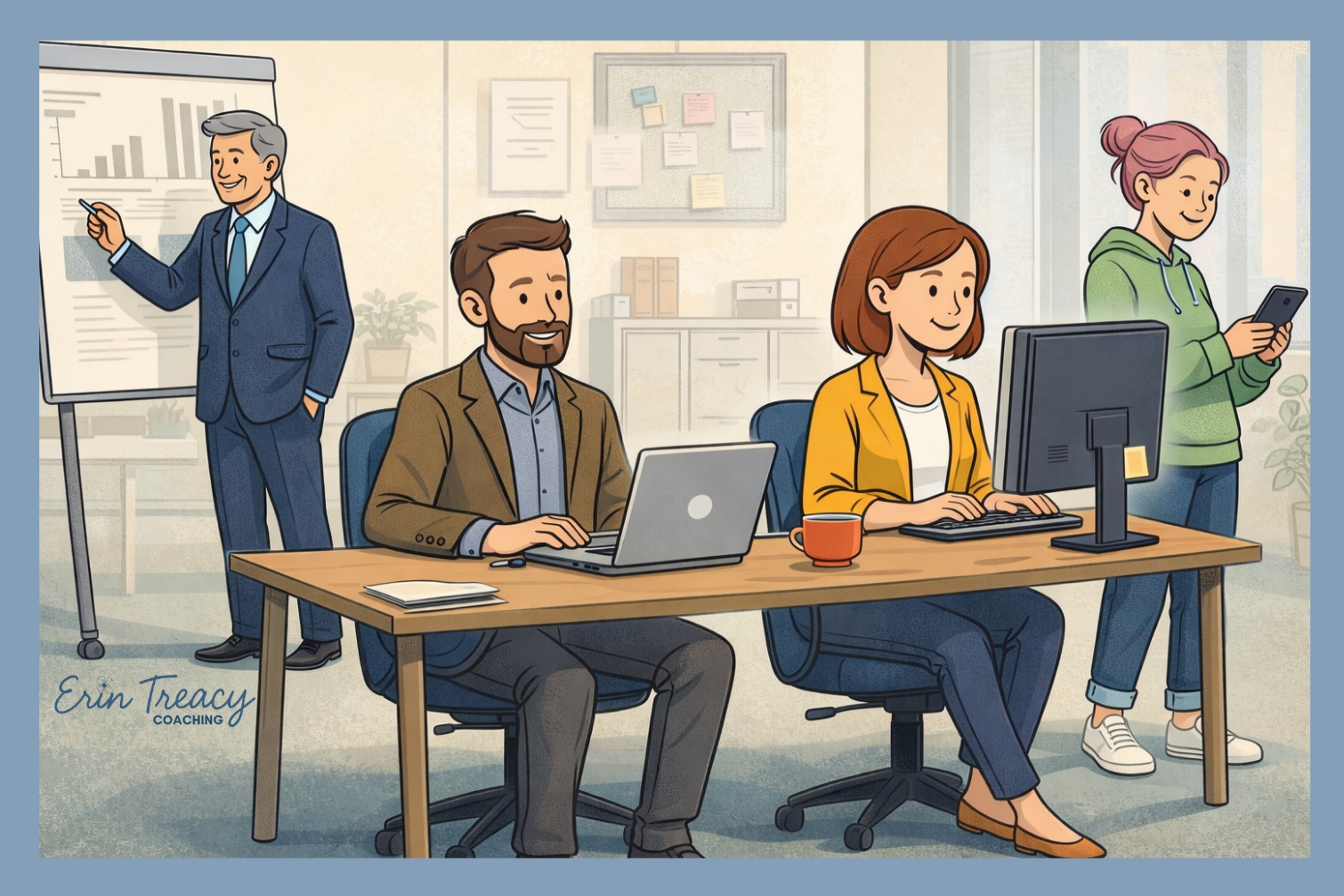
A senior employee posted recently:
“I asked my team to follow the process we’ve used for years. One of the younger employees asked why we do it that way. I’ve been doing this for 25 years. It felt like my experience didn’t matter.”
In the same discussion thread, a younger employee wrote:
“I ask questions because I want to understand. When my manager says ‘just do it,’ it feels like my input doesn’t matter.”
Same workplace.
Same goal.
Both feeling disrespected.
This is what generational differences in the workplace look like in real time.
The issue is rarely work ethic.
It is interpretation.
How Generational Differences in the Workplace Shape Respect and Professionalism
Professionalism was not handed down through a universal handbook. It was modeled.
Some professionals learned respect in structured environments where tenure and loyalty built credibility.
Some learned it during economic instability where independence and efficiency were survival skills.
Some entered work during the rise of collaboration and open communication.
Some began their careers in a digital world where transparency and alignment between words and action are expected.
Each generation absorbed what worked in their formative years.
That became their internal definition of respect.
For one person, accountability means staying until the job is complete.
For another, accountability means delivering results efficiently and protecting time.
For another, it includes development conversations and shared input.
For another, it includes clarity and alignment from the start.
None of these are wrong.
But when we assume ours is universal, friction grows.
Why Respect at Work Feels Different Across Generations
Search trends show steady interest in phrases like:
• Generational conflict at work
• Managing Gen Z employees
• Multigenerational workplace communication
• Why younger workers leave jobs
• How to give feedback across generations
Underneath all of those questions is one central concern:
What does respect look like now?
In previous decades, professionalism appeared more uniform.
Dress formally.
Follow the chain of command.
Earn credibility over time.
Today, professionalism can look like:
Questioning processes openly.
Expecting flexibility.
Requesting quicker feedback.
Prioritizing efficiency over visibility.
Respect has not disappeared.
The definition has expanded.
And expansion always creates tension before it creates understanding.
Common Generational Misunderstandings at Work
Here is where assumptions sneak in.
Questions get interpreted as defiance.
Silence gets interpreted as disengagement.
Direct feedback gets interpreted as harshness.
Collaboration gets interpreted as inefficiency.
But behavior is visible.
Meaning is personal.
Most generational misunderstandings at work are not about intent.
They are about perspective.
Sometimes meetings feel like a quiet version of “talkin’ ’bout my generation.” Each person defending the era that taught them how to work.
When perspective turns into assumption, respect feels complicated.
Communication Across Generations: What Gets Lost in Translation
Different generations often approach communication differently.
Some value direct, formal language.
Some prefer concise efficiency.
Some want open discussion and feedback.
Some expect quick clarity and alignment.
When communication style differs, we tend to personalize it.
Instead of asking: “What shaped this approach?”
We think, “Why are they like this?”
Understanding replaces defensiveness.
And that is where progress begins.
Accountability in a Multigenerational Workplace
Accountability is one of the most misunderstood areas across generations.
For some, accountability equals consistency and reliability.
For others, accountability equals results.
For others, it includes growth and development.
For others, it includes clarity and alignment from the beginning.
Gallup research consistently shows clarity of expectations is one of the strongest drivers of engagement across age groups.
Clarity protects respect.
When expectations are invisible, assumptions fill the gap.
How to Reduce Assumptions and Build Understanding Across Generations
This is not about choosing a generation to side with.
It is about removing assumptions from interaction.
Here is a practical approach anyone can use.
1. Separate Behavior From Meaning
Before reacting, pause.
What actually happened?
Was it a question.
Was it silence.
Was it a request for flexibility.
Was it direct feedback.
Then ask:
What story am I attaching to this?
Behavior is neutral.Interpretation creates tension.
2. Get Curious About What Shaped It
Each generation learned work under different conditions.
Instead of deciding which style is correct, ask:
How did this person likely learn to work?
Not to excuse behavior.
To understand context.
Curiosity lowers defensiveness on both sides.
3. Make Expectations Visible
Most friction in a multigenerational workplace comes from unspoken standards.
Say what accountability means.
Say what follow through looks like.
Say how communication should happen.
Say when it is appropriate to question a process.
Understanding does not lower the bar.
It makes the bar visible.
A Visual Guide to Understanding Generational Work Styles
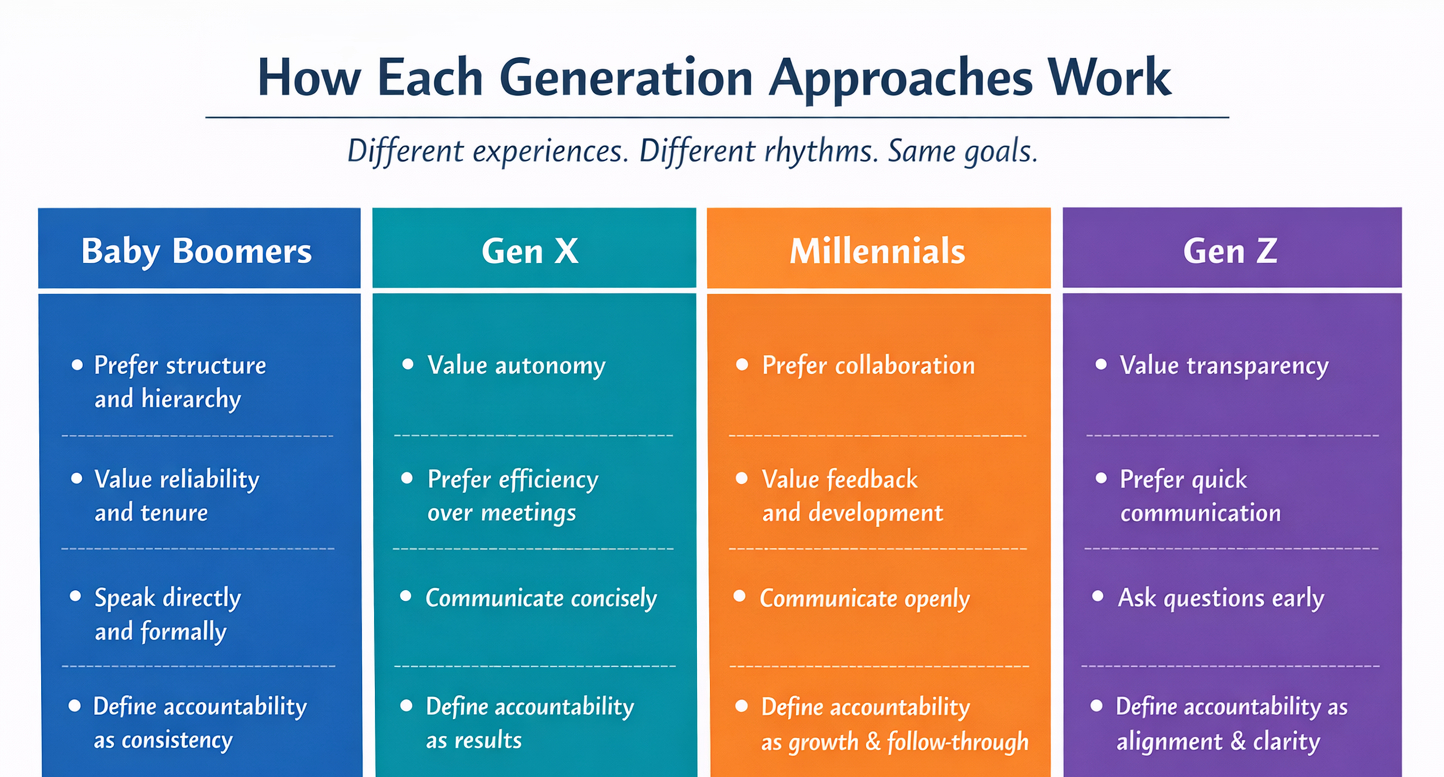
This chart is not about labeling behavior as right or wrong.
It highlights how each generation approaches work based on what shaped them.
Different experiences.Different rhythms.Same goals.
When we see approach instead of attitude, tension decreases.
For Leaders and For Everyone
If you lead, model clarity and invite perspective without lowering standards.
If you do not lead, ask for clarity instead of assuming dismissal.
Balanced workplaces are not built by eliminating difference.
They are built by understanding it.
Professionalism is no longer inherited.
It is co created.
Final Reflection
In your next tense moment at work, ask:
Is this about the task itself, or about how I learned work should look?
That question slows reaction.
It builds understanding.
And it turns generational differences in the workplace from a source of frustration into a source of strength.
Respect grows when perspective replaces assumption.
Ready to Strengthen Communication Across Generations?
Generational differences in the workplace are not going away. The organizations that thrive are the ones working to define expectations clearly and remove assumptions early.
If you want to build a stronger multigenerational workplace culture, start the conversation.
You can explore more practical leadership insights in the Nuggets of Knowledge Newsletter, or learn how I partner with teams through focused coaching and strategy sessions designed to create clarity, accountability, and connection.
Balanced workplaces are built intentionally.
Let’s build yours.
Frequently Asked Questions
Generational Differences in the Workplace
What are generational differences in the workplace?
Generational differences in the workplace refer to variations in communication styles, expectations, accountability standards, and definitions of professionalism shaped by the era in which employees began their careers.
Is generational conflict really about work ethic?
In most cases, generational conflict is not about effort. It is about differing perspectives on how work should be approached and how respect is demonstrated.
Why does respect feel different across generations?
Respect feels different because each generation learned workplace norms under different economic, cultural, and technological conditions. These experiences shape how individuals define professionalism and accountability.
