

Nothing makes feedback conversations at work feel more exhausting than knowing you need to bring up the same issue again.
The one-on-one was on the calendar. You came in prepared, choosing your words carefully because you wanted to be direct without sounding harsh.
Quick Answer
Feedback conversations at work become more effective when leaders stop saving every concern for a formal meeting. Small conversations close to the work create room for context, reduce confusion and keep feedback from becoming heavier than the issue itself. A useful micro conversation names the moment, invites the employee to explain the process and ends with a clear next step.
The employee nodded and said, “Got it.” For a moment, the conversation seemed fine.
Then the missed update happened again. Another vague answer showed up in a meeting. Follow-through still needed another reminder.
Now the leader is not only thinking about the work. The leader is thinking about the next conversation.
A quiet script starts running before the meeting ever happens. How do I say this without making things worse? What if the employee pulls back? Would one more example make the concern easier to explain?
Most leaders know this moment. You can feel the conversation coming before it happens. It sits in the back of your mind while you answer email, handle customer issues, prepare for a board meeting or try to keep the rest of the team moving.
You know the conversation matters.
You also know it may be uncomfortable.
So the feedback gets delayed. The message gets softened. Instead of naming the issue clearly, the leader starts talking around it.
By the time feedback becomes a formal meeting, the issue often carries more weight than it needed to carry.
Many leaders are living in this cycle right now. They try to solve repeated problems inside long office conversations, extended one-on-ones and meetings with little movement on the other side.
The employee listens. The leader explains. Everyone leaves the room.
Next week, the same issue shows up again.
At some point, feedback starts to feel like a ghosting session. Everyone showed up. The meeting happened. The words were said. Still, nothing moved.
Feedback should not live only inside scheduled one-on-ones, corrective meetings or “we need to talk” moments.
The best feedback cultures are built in small, consistent conversations before problems become patterns.
Why feedback conversations at work get too heavy
Most leaders know when something needs attention.
A missed detail stands out. A vague update causes confusion. A meeting tone feels off. Follow-through, ownership or energy begins to shift.
Awareness usually is not the problem.
The harder part comes after the leader notices.
The conversation starts before anyone speaks
Before anyone says anything, the whole conversation starts to play out in the leader’s mind. The employee might go quiet, push back or leave the meeting discouraged. Second guessing follows quickly. Maybe the timing is wrong. One more example might make the concern easier to explain. Bringing it up today could make the working relationship feel strained tomorrow.
So the leader waits.
One missed moment becomes two. A small concern becomes a pattern. A simple correction turns into a larger conversation with more pressure attached.
By the time the leader finally brings it up, the employee may be hearing the feedback for the first time, while the leader has been carrying it for weeks.
Now the conversation has two different timelines. The leader feels tired of the issue. The employee may feel surprised by the intensity. No one is starting from the same place.
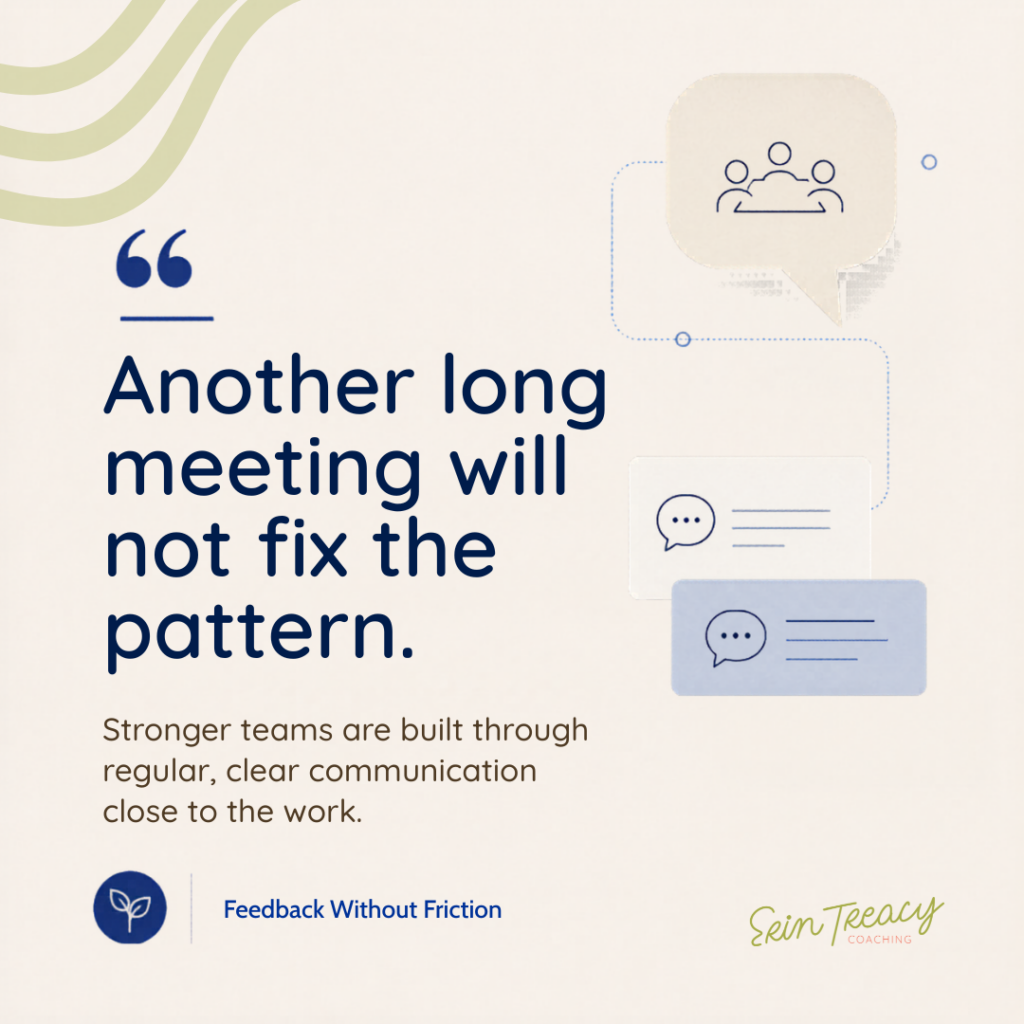
Another long meeting will not fix the pattern. Stronger teams are built through regular, clear communication close to the work, not one more drawn-out conversation after frustration has already built.
CIPD’s performance management guidance points in the same direction. Performance management works best as a continuous cycle rather than an isolated event, with regular, timely feedback focused on improvement.
How micro conversations at work prevent bigger feedback problems
Micro conversations at work are small, purposeful conversations close to the moment.
They are not formal reviews, lectures or long meetings behind a closed office door. A micro conversation can happen after a meeting, during a quick conversation, before a deadline or when confusion first appears.
Micro conversations are not about catching someone doing something wrong. Used well, they create enough clarity for both people to understand what is happening before a small issue becomes a pattern.
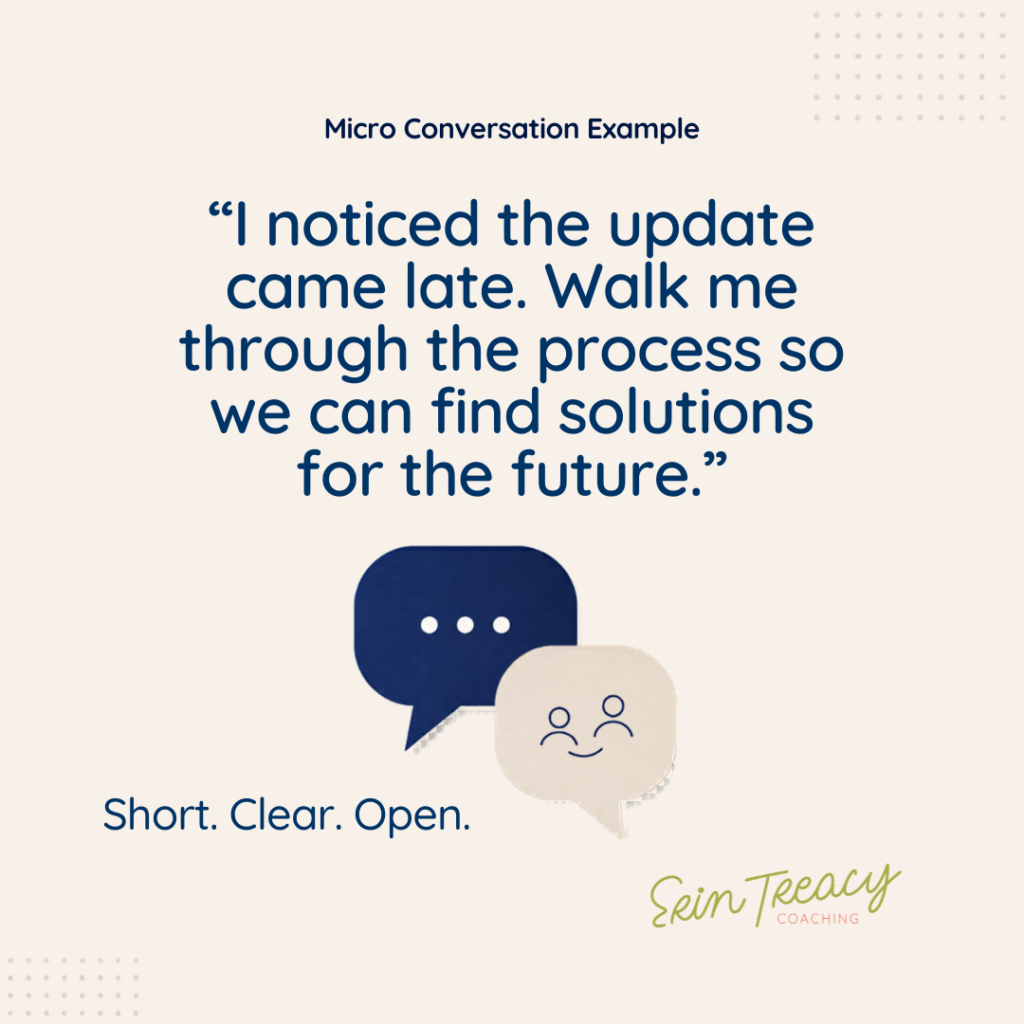
A simple micro conversation might sound like this:
“I noticed the update came late. Walk me through the process so we can find solutions for the future.”
Short. Clear. Open.
By naming what happened without deciding why it happened, the leader leaves room for context. Delays, missing information, competing priorities or unclear expectations may all be part of the process.
Small conversations work best when they create understanding before correction, keeping feedback from becoming heavier than the issue itself.
Research published in PLOS ONE found managers felt more motivated to improve when feedback conversations focused on future actions instead of past performance.
Good feedback does not begin with a verdict. It begins with enough clarity for both people to see the same picture.
Small conversations build trust before tension builds
Trust does not grow only during big conversations.
It grows through repeated moments where people learn what to expect from each other.
Clear, timely feedback sends an important message: “You will not have to guess where you stand with me.”
Some employees lose confidence when they sense frustration but do not know what caused it. Shorter responses, a different tone, less patience or more control from the leader may leave them guessing.
Guessing does not give people a clear path to better performance. It can create anxiety, silence, defensiveness or withdrawal.
Small conversations reduce guessing because the leader can name what they notice before the issue becomes tense. The employee gets a chance to ask questions, clarify expectations and adjust before anyone starts building a story about motivation or attitude.
A conversation of two minutes can uncover what a long meeting might miss.
An employee may have misunderstood the priority. Another person may still need to provide information. A deadline may not have seemed connected to a larger decision. The leader may expect one outcome while the employee believes the expectation looks different.
Leaders often want employees to speak up sooner, ask better questions and take more ownership. Those behaviors become much more likely when the communication rhythm makes small conversations feel normal.
What if your feedback conversations at work already feel heavy?
Starting fresh makes this sound simple. Many leaders are not starting fresh.
The one-on-ones already feel long. Office conversations feel tense. An employee may seem guarded. The leader may feel tired of repeating the same point.
Another long meeting will not fix the pattern.
A better starting point is resetting the rhythm.
Try naming the shift clearly:
“I want to change how we handle feedback and check-ins. I do not want us waiting until something becomes a bigger issue before we talk about it. Moving forward, I want us to have smaller conversations closer to the work so expectations stay clear.”
This lowers the surprise and explains why the pattern is changing. It also makes feedback part of the working relationship instead of something reserved for correction.
Consistency matters next.
A new rhythm may feel awkward at first, especially when people are used to feedback appearing only after something goes wrong.
Keep the conversations short. Stay specific. Tie feedback to the work. End with a clear next step.
The goal is not to turn every small moment into a performance discussion. Leaders need to stop saving small concerns until they become heavy conversations.
A feedback framework for managers who want clarity without conflict
A feedback framework for managers does not need to sound corporate or scripted. It needs to work in the middle of a real workday.
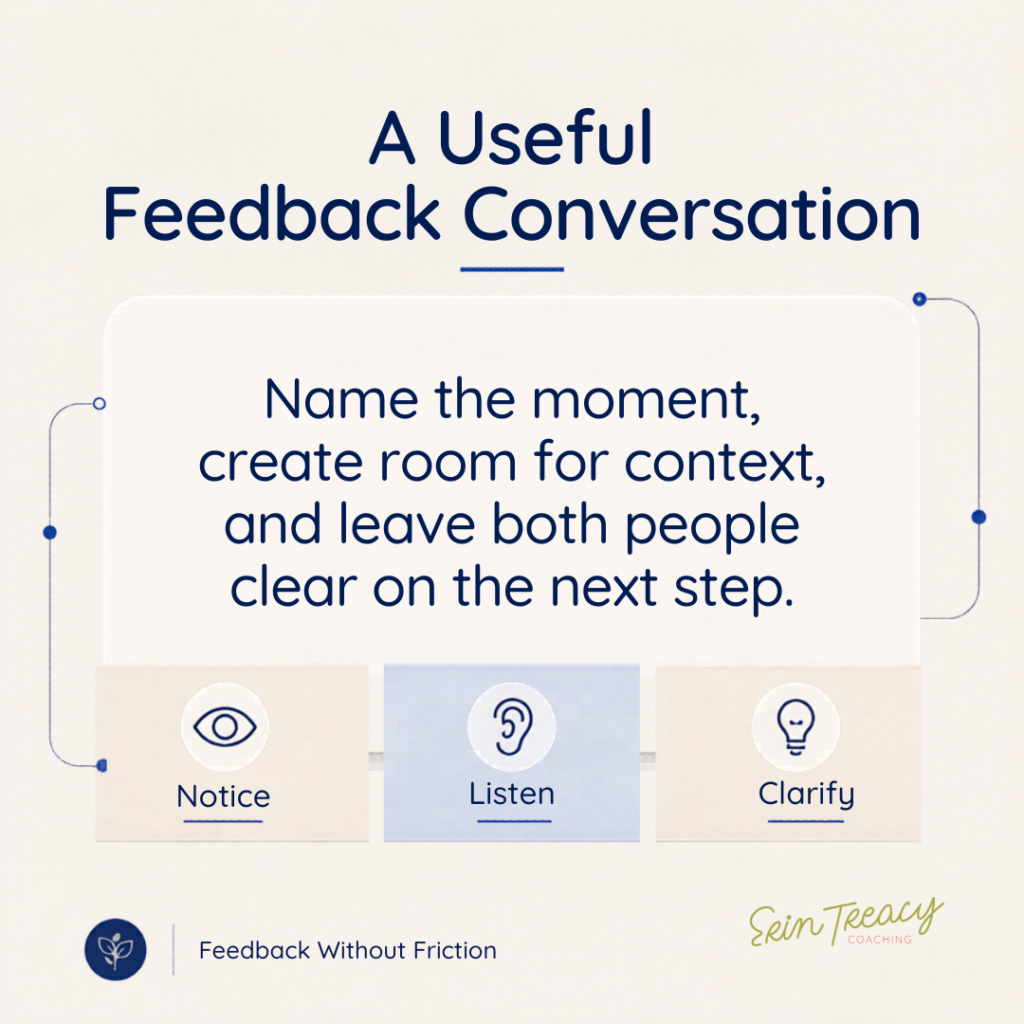
A useful feedback conversation should name the moment, create room for context and leave both people clear on the next step.
The middle part matters most. Many feedback conversations jump from observation to correction. Strong leaders slow down long enough to listen before deciding what needs to change.
What to say instead of vague feedback
Instead of saying, “You need to communicate better,” try:
“When the project update came in after the team meeting, we lost the chance to make decisions while everyone was together. Walk me through the timing.”
From there, the next step becomes clearer:
“For next week, let’s decide what needs to be in the update and when it needs to be sent so the team has what it needs.”
Instead of saying, “Take more ownership,” try:
“I noticed the project stalled before the deadline. Help me understand where it got stuck and what support or decision would have moved it forward sooner.”
After listening, the leader can clarify the expectation:
“Next time a project feels stuck, I want us to identify the obstacle earlier so we can decide the next step before the deadline is at risk.”
Instead of saying, “Be more engaged,” try:
“I noticed we did not hear much from you in today’s meeting. What were you noticing during the discussion?”
Once the employee responds, the leader can add direction:
“Your perspective matters in those conversations. For the next meeting, let’s plan for you to bring one update or one question connected to your work.”
This kind of feedback does not lower the standard. It makes the standard clear while leaving room for context.
The employee knows what success looks like. The leader has a clearer way to follow up. The conversation becomes less about personality and more about behavior, impact, listening and next steps.
How Gen Z workplace communication benefits from clearer feedback
Gen Z workplace communication often improves when expectations are clear, context is invited and feedback feels useful instead of delayed or loaded with frustration.
Younger employees do not need leaders to soften every standard. They need leaders to make the standard visible.
Vague phrases create confusion:
“Be more professional.”
“Communicate better.”
“Take more ownership.”
“Show more initiative.”
“Be more engaged.”
Each phrase may point to a real issue, but none gives enough direction on its own.
Professionalism could mean tone, timing, appearance, preparation, follow-through, meeting behavior, email style or client communication.
Ownership could mean making decisions sooner, following up faster, identifying problems earlier or completing work without reminders.
Engagement could mean speaking in meetings, asking questions, showing energy, taking initiative or participating in team discussions.
A phrase with too many possible meanings forces the employee to guess. Guessing creates anxiety, distance and disengagement.
Clear feedback closes the gap.
Instead of saying, “Take more initiative,” try:
“I noticed the project paused before the next step was clear. Help me understand what made it hard to move forward.”
Then move toward clarity:
“Next time, bring me the obstacle and one possible next step before the deadline is at risk.”
This does not lower the standard. It makes the standard visible while giving the employee a chance to share what happened.
Micro conversations are not micromanagement
Some leaders worry small feedback conversations will feel like micromanagement. They can, if every comment feels critical, controlling or constant.
Micro conversations are different.
They are not about keeping score. They are about keeping the work aligned.
Tone, timing and purpose matter.
A micro conversation should sound like a leader creating clarity, not a leader watching for mistakes.
Useful phrases include:
“Let’s pause here before this becomes more complicated.”
“I want to understand what got in the way before we decide the next step.”
“Help me see what you are seeing.”
“Before we move on, let’s make sure the next step is clear.”
“What support or decision would make this easier to move forward?”
These phrases create direction without turning the moment into a lecture.
Employees need space to work, think and solve problems. They also need enough feedback to know whether they are moving in the right direction.
Finding the balance is leadership.
Better feedback conversations create better accountability
Leaders often tell me they want more accountability.
They want employees to follow through, solve problems sooner, need fewer reminders and create fewer surprises.
Those expectations are fair.
Accountability becomes stronger when expectations are clear enough to measure.
A leader who says, “We already talked about communication,” may feel completely justified. The employee may believe they communicated more because they sent two extra messages.
Both people can be telling the truth from their own point of view.
A clearer follow-up sounds like this:
“Last week we agreed on a Friday update with three pieces: what is complete, what is still moving and where you need a decision. Walk me through what worked and what got in the way.”
Now the conversation has something solid to stand on. It points back to a clear agreement and gives both people something real to evaluate.
Better management communication skills reduce the emotional fog around accountability. The leader does not have to rely on frustration, and the employee does not have to rely on guessing.
Practical steps leaders can use this week
Start smaller.
Do not wait for the next formal one-on-one when the issue can be addressed in two minutes.
Name what you noticed. Ask what context you may be missing. Listen for the process before deciding the solution.
A simple micro conversation might sound like this:
“I noticed the update came late. Walk me through the process so we can find solutions for the future.”
Short. Clear. Open.
The leader names what happened without deciding why it happened. The employee has room to explain the process, including delays, missing information, competing priorities or unclear expectations.
Small conversations work best when they create understanding before correction. They keep feedback from becoming heavier than the issue itself.
Leaders can also use a simple rhythm after meetings or before deadlines:
Ask what feels clear.
Name any missing decision.
Confirm ownership before people leave the room.
Invite context before deciding the fix.
Close with one next step.
Micro conversations do not replace formal work conversations. They reduce the number of formal conversations needed because expectations stay closer to the work.
FAQ
What makes feedback conversations at work more effective?
Effective feedback conversations at work are timely, specific and open enough for context. A leader names what they noticed, listens for what may be missing and agrees on the next step.
What are micro conversations at work?
Micro conversations at work are short, focused conversations close to the moment. They create clarity before a small issue becomes a larger pattern. They should feel open, specific and connected to the work, not like a lecture.
Why do feedback conversations feel so heavy?
Feedback feels heavy when leaders wait too long, frustration builds or the conversation tries to solve too much at once. A small concern becomes harder to discuss after it turns into a pattern. Short, timely conversations keep the issue easier to understand and easier to correct.
Are micro conversations the same as micromanagement?
No. Micromanagement controls the work. Micro conversations create clarity around the work. A good micro conversation is short, specific and open enough for the employee to explain context. The leader listens before deciding the solution.
How can managers give feedback without blaming the employee?
Start with what you noticed, then ask the employee to walk you through the process. For example: “I noticed the update came late. Walk me through the process so we can find solutions for the future.” This keeps the conversation open and avoids blaming the employee before the leader understands what happened.
Final thoughts
Leaders do not need to avoid hard conversations.
They need to stop waiting until every feedback conversation becomes hard.
A quick clarification today can prevent a tense meeting next month. A reset after a meeting can prevent weeks of misalignment. A clear question before frustration builds can give an employee the chance to explain, adjust and grow.
Feedback should become part of the normal rhythm of work, not a surprise, a punishment or a meeting everyone quietly dreads. Done well, feedback becomes development.
Trust and accountability can grow in the same conversation.
Leaders stop having the same exhausting conversation twice when small moments start doing the work before problems become patterns.
If feedback has started to feel heavier than it should, it may be time to look at the communication rhythm around the work, not just the words used in the formal meeting. This is the kind of work I do with leaders and teams: building practical communication habits so accountability, trust and performance can grow before the next hard conversation becomes harder. Let’s talk about how.
