

What employee development reveals about leadership, engagement, morale and business growth.
When an office light first fails, replacing the bulb appears logical.
A team member retrieves a new one from the supply closet, pulls over a chair and corrects the visible issue. The task is simple.
One week later, the same light begins to flicker. Another bulb goes in. Perhaps the first one was old, or a bad batch arrived in the box. The fix remains practical, so nobody spends much time considering the recurrence.
Then the light fails again.
By the fourth replacement, the narrative changes. Leaders stop asking who purchased the faulty bulbs and begin asking a much more uncomfortable question:
Why does this keep happening?
Eventually, someone must look behind the drywall. The bulb is not the problem. The issue exists in the wiring.
Businesses operate in this manner more often than many leaders realize. A specific position experiences constant turnover. Communication fractures between the same two departments every month. A manager repeats a corrective conversation every week without seeing meaningful change.
The visible problem captures attention because it is easy to observe. The deeper issue remains hidden because no one has paused long enough to inspect the systems surrounding the work.

The high cost of surface level fixes
When a problem repeats, most organizations reach for the answer closest to the surface. This is the seduction of the quick fix.
Leaders might replace the employee, schedule another meeting, monitor a new metric or revise a policy.
Each response feels productive because it is visible. Leadership can point to the action as evidence of progress. Action matters, and movement is visible.
However, movement is not the same as understanding.
A business can remain busy fixing symptoms while the root cause stays untouched. Hiring a new person for a struggling role may look like progress, but if the wiring of the role is frayed, the next person will likely mirror the previous failure.
This cycle costs time, money and trust.
A leader assumes the employee is the problem. The individual feels unsupported and disengages. The manager grows frustrated by the repetition of the same conversations. Before long, the wiring problem is no longer a hidden technical issue. It becomes part of the company culture.
Movement is not the same as understanding.
Erin Treacy
Repeated problems are information
A single issue might be an isolated incident.
A repeated issue is information.
Your dashboard might show turnover has increased or productivity has dipped. These figures matter. They represent the flickering light. They rarely show the wiring.
A report will not reveal an employee failed to understand what success looked like in the role. It may not capture the manager who earned a promotion for technical skill but never received development on how to lead people.
Research continues to support this leadership reality. Gallup reports managers account for at least 70% of the variance in team level employee engagement. Gallup also connects employee engagement at the business unit level with performance indicators such as customer ratings, profitability, productivity, quality, lower turnover and fewer safety incidents.
SHRM’s 2025 CHRO research points in the same direction. More than half of CHROs identified leadership and manager development as a top priority for 2025, making it the most frequently cited focus among those leaders.
The numbers support what many leaders already feel. Workplace problems rarely live in only one place.
They manifest through unclear expectations, leadership strain, broken workflows, communication gaps and missed development opportunities.
When leaders manage from a distance, they often manage through assumptions. In a growing business, assumptions are expensive.
Employee development and business growth start with visibility
Employee development is often described as a way to improve performance.
While true, development also serves as a tool for leaders seeking to understand the internal mechanics of their business. Development provides visibility.
Through coaching, honest dialogue and regular observation, leaders begin to see the factors shaping performance instead of only judging the final result.
A disengaged employee might be navigating confusion they cannot easily name.
An ineffective manager may be operating without a clear model for leadership.
Resistance from a team can reflect months of inconsistent communication rather than a lack of commitment.
Development conversations bring these issues into the open. They reveal where people are guessing, where managers need support and where the business has failed to make the work clear.
LinkedIn’s 2025 Workplace Learning Report connects learning and career development with organizational adaptability, employee engagement and business readiness. The report also points to learning as a strategic driver for building skills inside organizations as work changes.
For leaders, the return on investment is clear.
Development is not only about making people feel valued.
It provides the business with superior information.

Engagement is more than a vibe
Engagement gives leaders access to truth.
People in a regular rhythm of development with their leaders are more likely to share what feels unclear, where they feel stuck and what kind of support would allow them to perform better.
Real development does not happen only during a yearly review. It is not a slogan on the wall. The work occurs in the daily and weekly rhythm of asking better questions:
- What part of this role still feels unclear?
- Where are you required to work around our current process?
- What decisions do you feel confident making on your own?
- Where do you need more ownership?
- What keeps pulling you away from your best work?
Better questions yield better information. Superior information leads to stronger decisions. Stronger decisions create healthier systems.
This is how employee engagement connects to business growth.
Employee engagement is not just morale work. It gives leaders access to truth.
Erin Treacy
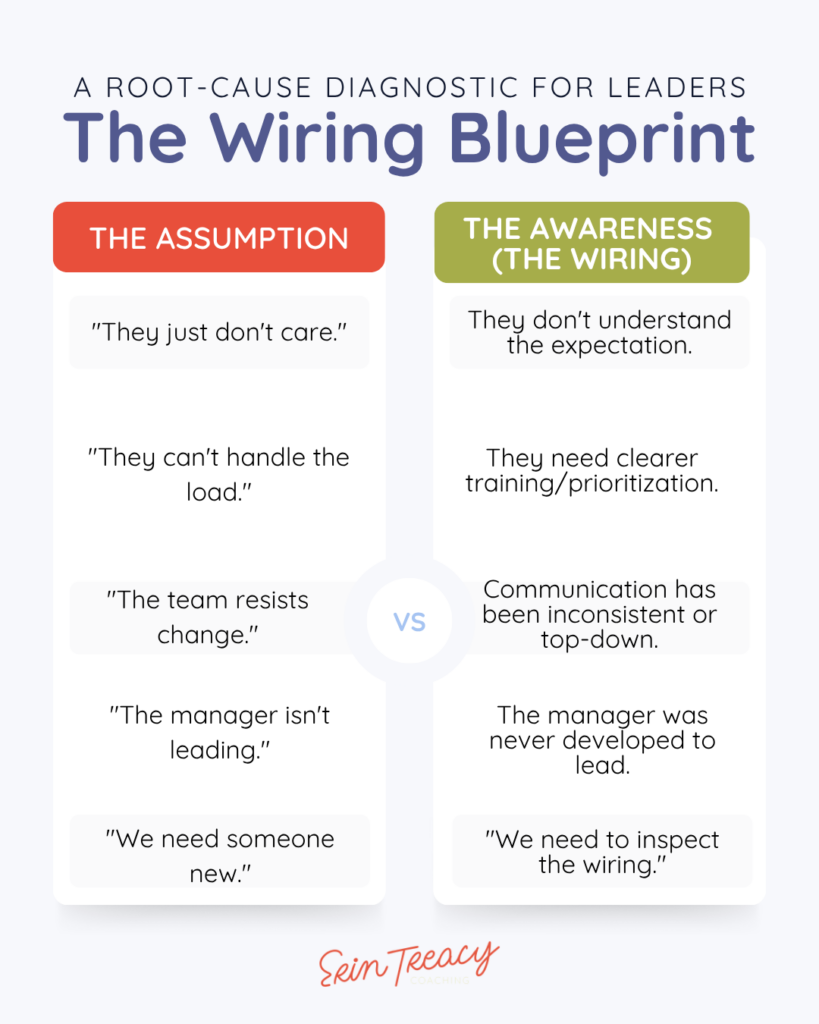
The Wiring Blueprint: Moving from assumption to awareness
Most wiring issues begin in the small workarounds people learn to accept.
Employees stop asking questions because they do not want to look unprepared.
Managers carry decisions the team could handle with better training.
Departments interpret the same process in different ways.
Meetings end with nodding heads, then everyone walks away with a different understanding of next steps.
Responsibilities get assigned to several people, but no one clearly owns the final outcome.
These gaps create larger problems over time. A lack of clarity becomes a performance issue. A weak handoff becomes a customer service issue. An unsupported manager becomes a morale issue. A poor onboarding process becomes a turnover issue.
The business may classify these as people problems because people are where the symptoms appear.
Symptoms, however, are not always the source.
Retention improves when people are not left guessing
Turnover is expensive. The deeper cost is the loss of momentum.
The business burns time retraining a new hire for a role where the same underlying problems still exist.
Research from the Center for American Progress found the typical cost of turnover is about 21% of an employee’s annual salary, with much higher costs for complex, specialized or senior-level roles. The cost comes from lost productivity, hiring time, onboarding, training and the slower ramp-up period while a new employee learns the role. The financial cost matters, but the operational cost reaches further.
The financial cost matters, but the operational cost reaches further.
A manager starts over again.
The team loses confidence.
Customers experience inconsistency.
The business loses momentum while everyone trains another person for the same role, with the same hidden issues still in place.
To change the outcome, leaders must change what they notice.
Instead of assuming someone simply is not getting it, a leader can ask whether the expectation was ever defined.
Rather than labeling the team resistant, leadership can examine whether communication has been clear, consistent and two way.
Before blaming a manager for weak leadership, the business can ask whether the manager was ever developed to lead.
Awareness shifts the response from reaction to responsibility.
People first leadership is practical leadership
People first leadership is sometimes misunderstood as soft. It is actually a strategic practice because it pays attention to the humans closest to the work before making broad assumptions about their capability.
This approach maintains standards. Leaders create the conditions where standards can be understood, practiced and met.
- A people first leader still expects accountability.
- A people first business still measures performance.
- A people first system still has goals, deadlines and financial pressure.
The difference is where the leader looks when the same problem returns.
- A surface level response says: “We need someone better.”
- A people first response asks: “What is this pattern showing us?”
This question moves the business from blame toward clarity. It gives owners and senior leaders a better view of the business they are actually running, not just the one represented on a dashboard.
If your business has repeated communication gaps, turnover in the same roles or managers stuck in the same conversations, this is where people first business systems become practical. They create clearer roles, stronger workplace communication and shared ownership before frustration becomes culture.
Employee development and business growth depend on stronger systems
Growth becomes sustainable only when it is not built on one exhausted leader holding a strained system together.
A stronger business depends on clear expectations, capable managers, shared ownership and employees who know how to contribute with confidence.
Employee development is not separate from business growth. It is how leaders learn what the business actually needs.
When development becomes a regular leadership practice, leaders start noticing patterns earlier. They see where people are losing confidence. They recognize overloaded managers before burnout takes over. They catch unclear handoffs before customers feel the impact.
This awareness gives the business more than better morale.
It creates operational clarity.
Strong employee development, healthy engagement and clear communication become part of the wiring of the business. They strengthen the way people work, the way leaders respond and the way teams grow.
For leaders who need a more structured path, leadership and management coaching can create space to examine these patterns, develop managers and build stronger systems around the people doing the work.
A practical diagnostic for leaders
The next time a familiar problem lands on your desk, pause before reaching for the obvious fix.
Ask:
- Is this a training issue?
- Is this a workflow issue?
- Is this a clarity issue?
- Is this a manager development issue?
- Is this a communication issue?
- Is this a leadership attention issue?
- Is this a system issue showing up through a person?
The answer may not be found in one more metric. It may be found in the conversation leadership has not had yet.
Quick check: Is this a people problem or a wiring problem?
If the same issue keeps showing up, ask yourself:
- Have expectations been clearly defined?
- Has the employee been developed for the work they are being asked to do?
- Does the manager have the tools to coach instead of only correct?
- Are workflows clear enough for people to follow consistently?
- Do team members understand who owns each decision?
- Are people afraid to ask questions until a mistake has already happened?
- Do managers have a consistent model for how leadership should look?
- Are repeated problems being discussed as patterns or treated as isolated frustrations?
If several answers feel unclear, the problem may not be the light bulb.
It may be the wiring.
The leadership takeaway
Replacing the bulb makes sense the first time.
It may still make sense the second time.
By the fourth replacement, it is time to look behind the wall.
The same is true in business.
When the same role keeps turning over, the same communication problem keeps surfacing or the same manager keeps struggling, the issue may not be solved by replacing another person, adding another meeting or tracking another number.
The business may need to inspect the wiring.
This wiring includes employee development, workplace communication, leadership systems, role clarity, accountability and shared ownership.
When those pieces connect, people perform with more confidence and the business grows with less chaos.
Let’s look at the wiring
If repeated turnover, communication breakdowns, leadership overload or morale issues are slowing your growth, the answer may not be another quick fix.
It may be time to look at the wiring.
I work with leaders and organizations to strengthen employee development, leadership systems, workplace communication and operational clarity so people can perform with more confidence and businesses can grow with less chaos.
Book a clarity call or send me a message to start wiring your business for growth.
FAQ: Frequently Asked Questions
A single performance issue may be isolated. A repeated issue usually deserves deeper attention. When multiple employees struggle in the same role, communication breaks down in the same place or managers repeat the same corrective conversations without change, the business may be dealing with a system problem. The issue could involve unclear expectations, weak training, poor onboarding, inconsistent communication or a lack of manager development.
Employee development and business growth are connected because development gives leaders better visibility into how work actually happens. Regular coaching and development conversations show where employees feel confident, where they are guessing and where workflows create confusion. This information allows leaders to improve communication, strengthen accountability and reduce preventable turnover.
Common signs include repeated misunderstandings, unclear ownership, inconsistent messages between departments, employees working around broken processes and managers answering the same questions repeatedly. Poor workplace communication often appears as a people problem first, but the root cause may be unclear systems or a lack of leadership alignment.
Employee engagement improves retention when people feel connected to the work, clear about expectations and supported by leadership. Gallup’s turnover research found 42% of voluntary leavers believed their manager or organization could have done something to prevent their departure. Regular conversations about job satisfaction, performance and future growth give leaders a chance to address issues before employees decide to leave.
Outside support can be useful when the same problems keep returning and internal fixes are not changing the outcome. Repeated turnover, leadership overload, communication breakdowns and unclear accountability are signs a business may need a more objective review of its people first systems, leadership structure and operational clarity.
People first leadership does not reduce accountability. It strengthens accountability by making expectations clearer. Employees are more likely to meet standards when they understand what success looks like, have the tools to do the work and receive feedback before problems grow. Accountability becomes healthier when leaders combine clear standards with consistent communication and development.
A people first business system creates structure around how people communicate, make decisions, share ownership and manage work. It connects leadership habits with operational clarity. These systems reduce confusion, strengthen manager consistency and make it easier for employees to perform with confidence.
Leaders inspect the wiring by looking beyond the visible symptom. Instead of stopping at turnover, missed deadlines or employee frustration, they examine training, workflows, communication patterns, role clarity, manager support and decision ownership. Development conversations, team feedback and operational review all reveal where the wiring may be loose.
