


A friend of mine posted a question online recently, and it stopped my scroll. Whatever happened to RSVP etiquette?
I asked what prompted it. Her answer is a story every leader, volunteer coordinator and event host will recognize.
The Meeting Nobody Answered
She was planning a meeting for a volunteer organization working on a project together. The invitations went out. No replies came back.
Reminders followed, asking people to let her know if they were coming. Still nothing. She could see people had clicked yes on the calendar invite, but nobody actually wrote back.
Meanwhile, the decisions kept piling up. How much food? The larger room at the event space or the smaller one? How many tables and chairs?
So she sent one more reminder, this time explaining exactly why she needed a head count. A few thumbs up came back.
Got it? I’m coming? I’ll get back to you? She had no idea what any of them meant.
Turnout looked so low the group almost canceled. Then, 20 to 45 minutes after the start time, the room began to fill.
Fashionably late works at a party. This was a meeting with a speaker, new ideas and plans for upcoming work. By the time the younger members trickled in, the speaker was almost done. The last of them walked through the door after the talk had ended.
Nobody knew if or when they were coming, so there was no way to hold the speaker. The late arrivals were a little annoyed they missed it. Asked what happened, they didn’t see the big deal. Some said they weren’t sure they would feel like coming.
Every Gen X and baby boomer member had responded. The silence came almost entirely from Gen Z, with a few millennials in the mix.
What Does RSVP Actually Mean?
RSVP comes from the French phrase répondez s’il vous plaît, or “please respond.” An invitation marked RSVP asks for a clear yes or no by a set date. Unless the host says otherwise, a reaction or a calendar click doesn’t cover it.
Good RSVP etiquette comes down to three habits: answer, answer on time and update the host if your plans change.
Is RSVP Etiquette a Generational Thing?
My friend wasn’t imagining the pattern. YouGov polled 1,000 U.S. adults in 2022. Among Americans under 30, 56% said they often agree to plans, then later realize they don’t want to go. For those 65 and older, the number was 12%.
Plans change, and nobody expects otherwise. Going quiet about it is what causes the damage. Once you know you can’t make it, tell the person who invited you right away. A “something came up” message sent at the last minute isn’t timely or respectful.
I don’t think most of the young adults in this story set out to be rude. A few things likely got lost in translation.
The calendar click. For someone used to answering invites with a single tap, clicking accept may feel like the whole job. To the host, it’s a button with no words attached.
The thumbs up. In a group chat, it usually means “seen it.” When you’re ordering food for a meeting, it tells you nothing.
The college mindset. Plenty of campus events let students drift in whenever they feel like it, and nobody counts chairs. A working organization with a speaker and an agenda runs on different rules.
What a Missed Appointment Really Costs

Wasted food and empty tables can feel like someone else’s problem. A haircut hits closer.
My hairstylist tells me about this all the time. A client cancels five minutes before an appointment, or never shows up at all. Two days later, the same client calls wanting to be fit in. When she can’t get them in, they’re annoyed.
Age has nothing to do with it. She sees it from clients of every generation.
“We think our own time is important. Everyone else’s time doesn’t even register.” ~ Erin Treacy
With five minutes’ notice, she can’t put anyone else in the chair. The hour is gone, along with the money she would have earned in it. For anyone paid by the appointment, a missed booking comes straight out of the paycheck.
We think our own time is important. Everyone else’s time doesn’t even register.
Flip the chair around, and most of us have sat on the other side. Maybe a friend bailed after you’d already gotten ready. A coworker skipped a shift, and you covered it. Or your text with a real question sat on read for two days.
Remember how it felt? Hosts feel the same way when the RSVPs never come. Ignoring an invite leaves someone on read.
And anyone who has organized something, even a group dinner, knows how hard it is to plan around silence.
“Ignoring an invite leaves someone on read.” ~ Erin Treacy
How to RSVP the Right Way
Nobody hands out a manual for this, especially early in a career. These habits cover most situations.
- Answer in words. “Yes, I’ll be there” or “Can’t make it this time.” An emoji or a calendar click falls short unless the host told you what it means.
- Say no without guilt. A clear no won’t count against you, and it helps the host far more than a silent maybe.
- Use the bubble honestly. Not sure yet? Try “I’m planning to come, but I’m on the bubble. I’ll know by Wednesday.” Then send the update, even if the answer turns into a no. The Emily Post Institute’s RSVP guide makes the same point: a maybe always needs a final answer.
- Give a heads up. Running late or stuck at work? One quick text lets the host adjust. If anyone had mentioned work schedules, my friend’s group could have pushed the meeting back 30 minutes.
- Pick late or early, not both. Arriving late means you don’t also get to leave early.
- Own the miss. Came in late and missed something? Showing up on time next time fixes it. Frustration with the people who started without you doesn’t.
What Leaders and Hosts Can Change
My friend’s post ended with the question every host eventually asks. What do we need to teach, or change, so we get the information we need?
Both, honestly. Young adults need the habits above, and hosts need invitations built for how people actually read them.
“People can’t hit a target they can’t see.” ~ Erin Treacy
Start with the ask itself. People can’t hit a target they can’t see, and “let me know if you’re coming” leaves too much room. Try “Reply yes or no by Thursday at noon so we can book the right room.” One sentence covers the deadline, the format and the reason.
The reason belongs in the first message, not the third reminder. A line like “we need a head count for food and seating” turns a vague request into something people understand.
Next, make answering easy. Every extra step costs you replies, and even a few steps can be more than a busy person will take. Think about your last doctor’s appointment reminder: C to confirm, D to cancel, R to reschedule. One letter, and you’re done.
Invitations can work the same way. Tell people what each reaction means: a heart if you plan to come, a smile if you’re not sure but want to. Anyone who sends a smile goes on a reminder list for a nudge closer to the date. Once you decide what a reaction means, the thumbs up problem disappears.
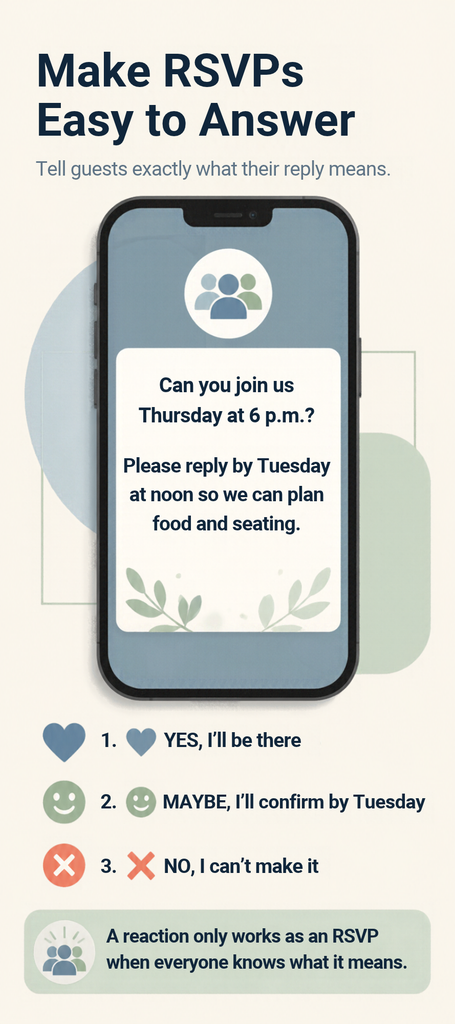
Clear stakes help, too. “This is a working meeting, and our speaker starts at 6 p.m. sharp” tells people exactly what they’d miss by running late.
Even with a perfect invite, some people won’t come, so order food and set chairs for fewer than your full list.
Afterward, talk with the late arrivals one on one. A calm conversation teaches more than a sigh in the moment. Most young adults want feedback and room to grow, and many have never had anyone explain what a host is counting on.
Frequently Asked Questions
Only if the host says so. In a group chat, a thumbs up often means “seen it,” so the host still doesn’t know if you’re coming. Some hosts assign meanings to reactions, like a heart for yes. Otherwise, reply in words: “Yes, I’ll be there” or “Can’t make it.”
Sometimes, but don’t count on it. Some hosts track calendar responses, and others never look at them. If the host asked you to reply directly, a calendar click isn’t enough. Send a short message confirming yes or no, especially for meetings with food, a speaker or limited space.
Digital invites make it easy to tap and forget, and many people treat a reaction as an answer. Some are keeping options open. In a 2022 YouGov poll, 56% of Americans under 30 said they often agree to plans, then later don’t want to go. Good RSVP etiquette means updating the host either way.
Give a deadline, a reason and an easy way to answer. Try “Reply yes or no by Thursday at noon,” or assign a reaction to each answer, like a heart for yes. Then plan food and seating for fewer people than your list, since some won’t show even after saying yes.
The Bigger Lesson Behind RSVP Etiquette
A reply to an invitation tells someone their time and planning matter to you. The food and the chairs are just where it shows up first.
The same habit carries straight into work: answering your boss, confirming a deadline, repeating back what’s expected so nothing slips. Follow through on the small stuff, and people trust you with the big stuff.
So the next time an invite lands in your inbox, skip the mystery thumbs up. Give a real answer, in whatever form the host asked for. Someone on the other end is counting chairs.
If your team or organization keeps running into communication gaps like this one, I help leaders close them. Book a time to talk, and we’ll figure out where the message is getting lost.
