

How to Prepare Your Team Before Vacation in 14 Days
Start by naming what makes leaving feel hard
It is 8:07 on a Monday morning, and your vacation starts in exactly two weeks.
The trip is on the calendar. The reservation confirmation is buried somewhere in your inbox. Someone at home has already asked if you are excited, and you said yes because, of course, you are.
You are excited.
You want the change of scenery, the slower morning, the meal where nobody asks a work question, and the chance to be present with your family, your friends, or maybe just yourself.
Then the workday starts.
An urgent client email lands before your coffee is finished. A team member texts because they need a decision before they can move forward. Another message pops up about an issue someone should be able to handle, but the ownership line is blurry. By midmorning, a small operational problem has started to grow because the process is more verbal habit than clear system.
Before lunch, the calm week you hoped for has already disappeared.
Make the invisible work visible
This is the part of vacation people do not talk about enough.
The trip sounds wonderful. Getting ready to be gone feels overwhelming.
If you want to prepare your team before vacation, start by making the invisible work visible.
Nobody books a trip hoping to answer emails from a hotel room, check messages at dinner, or step away from family because something “quick” came up. Leaving well means the work needs more than good intentions. It needs clear ownership, simple communication rules, and enough structure for people to move without every question circling back to you.
As the trip gets closer, your absence starts exposing everything unclear. Loose handoffs feel bigger. Vague ownership lines get louder. Decisions people still bring back to you become harder to ignore. Processes living in your head instead of somewhere useful suddenly look expensive.
You booked a vacation.
Without clarity, it can quickly become work from a different location.
The problem is not the trip. It is the scramble before you leave.
Most leaders and business owners do not take work on vacation because they love checking email from a hotel room.
They do it because leaving feels risky.
Too many decisions still route through them. Quick answers have become part of the job. Client issues depend on their judgment. Everyday problems have never been turned into a clear process.
Preparation often turns into overworking.
Late nights show up on the calendar. Every question gets answered. Long lists get made. Old issues get cleaned up. People hear, “Text me if you need anything.” The laptop gets packed “just in case.”
On paper, this looks responsible.
In real life, it creates the exact problem the leader wanted to avoid.
The team learns to wait. The leader stays available. Vacation becomes a softer version of work.
A better approach starts with a different question.
Instead of asking, “How can I get everything done before I leave?” ask, “What needs to be clear enough so the right people can move without me?”
Why leaders struggle to fully log off
Many leaders leave the office physically, but stay mentally on call.
Pew Research Center reported 46% of U.S. workers with paid time off do not use all of it. Among managers, the number rose to 54%. Common reasons included worries about falling behind and concern coworkers might have to take on extra work.
For leaders, those worries often come from experience.
They have returned from time away to a full inbox, stalled decisions, frustrated clients, and small problems that grew because nobody knew how to move. After enough of those returns, checking in starts to feel safer than fully stepping away.
The adjustments seem small at first.
Email gets checked once in the morning. Internal messages stay on the phone. Texts get answered if they look important. A laptop comes along, even with a promise not to open it.
One quick reply becomes three. A simple check in becomes an hour. Dinner gets interrupted. A quiet morning starts with email instead of rest.
It sounds responsible. It may even feel generous. But a week spent half working and half resting usually gives you the worst parts of both. You are not fully present with your family, your friends, or yourself. You are also not truly leading because you are reacting from a distance instead of building the structure people need to operate well.
A real vacation does not require every issue to disappear.
It requires enough clarity for normal work to keep moving without constant access to you.
The 14 Day Clarity Plan
The goal of this plan is not perfection.
The goal is fewer interruptions, clearer ownership, and stronger decision making while you are away.
Think of it as a short Chaos to Clarity reset with one specific target:
You are leaving in two weeks, and the work needs a plan that does not depend on you checking in.
The best way to prepare your team before vacation is to make ownership, communication, and escalation rules visible before you leave.
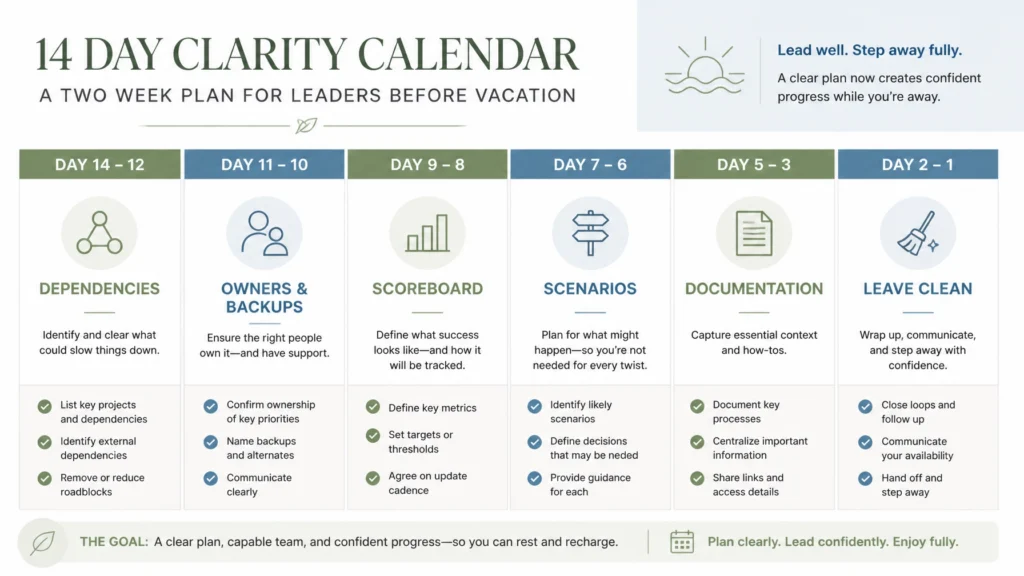
Day 14 to day 12: Find every dependency
Start with a fast dependency audit.
List every task, approval, decision, and conversation currently routed through you. Do not organize while you list. Get the truth on paper first.
Then sort each item into three groups:
Only I can do this.
Someone else can decide with guidance.
Someone else can fully own this.
Be honest. Leaders often overestimate how much truly needs their direct involvement. A capable person may not handle something exactly as you would, but 80% done well without your interruption is often better than 100% waiting on you.
Look first at repeat issues: client approvals, scheduling changes, team questions, vendor decisions, routine problem solving, staff coverage and internal friction.
Patterns matter more than one time problems. A single question may not create much disruption. The same question five times a week points to a clarity gap.
Ask yourself one hard question:
What keeps coming to me because people truly need me, and what keeps coming to me because I have trained people to wait?
Day 11 to day 10: Assign owners and backups
Unclear authority creates fake urgency.
When nobody knows who decides, everyone escalates. Before long, your phone is where decisions go, your inbox turns into the handoff plan, and your vacation depends on how often people need an answer.
For each recurring issue, assign a primary owner and a backup owner. Then write down the level of authority each person has while you are away.
A useful ownership plan answers five questions:
Which person owns the issue?
Who steps in if the primary owner is unavailable?
How far can this person go without approval?
Where should internal discussion happen before escalation?
Which situations truly need your attention?
Do not assume everyone understands the chain of command. Put it in writing. Add it to your project tool. Share it in an internal message. Review it during a meeting. Use the place your team already checks.
Ownership works only when people can see it.
Many leaders say they want employees to take initiative, yet they unintentionally keep authority vague. People hesitate because they are afraid of making the wrong call. Then the leader gets frustrated because no one moves without approval.
Clarity solves both sides.
Gallup has found 70% of the variance in a team’s engagement is related to management. That matters here because unclear leadership does not stay contained. It affects confidence, communication, decision making and follow through.
Day 9 to day 8: Build one simple scoreboard
Stop planning to manage from a beach chair.
Create one simple scoreboard for the team to use while you are away. A shared dashboard works. A one page tracker works. A daily summary works. The format matters less than the clarity.
Track only what matters most:
Top weekly priorities.
Open client issues.
Revenue related tasks.
Deadlines during your trip.
Team coverage.
Decisions made while you are out.
Avoid turning this into a 12 tab spreadsheet no one opens. The scoreboard should answer one question quickly:
Are the right things moving?
Visible work creates calmer communication. People ask fewer questions when they can see progress. Accountability also feels less personal when the work is tied to a shared tracker instead of a private conversation with you.
This is where people first business systems matter. A good system does not replace trust. It supports trust. It gives people enough information to act without guessing, hiding, or waiting for rescue.
Day 7 to day 6: Rehearse real scenarios
Do not wait for your trip to test your systems.
Pull your team together and walk through likely situations. Keep the conversation practical.
Use examples from real work, not generic what-ifs. A client may need an answer you usually give. A deadline could start slipping. Vendor trouble might hit during a busy day. Someone on the team may get stuck and look for quick direction. A disagreement could begin between two people who need to keep working together. A system may go down for half a day while everyone is already stretched.
After naming the situation, walk the team through the path forward:
Start with the person responsible for the issue.
Clarify the decision they can make without you.
Identify the resource, document or teammate they should check first.
Name the point where the issue becomes urgent enough to escalate.
This exercise exposes weak spots quickly. It also builds confidence. People cannot practice ownership in theory. They need real examples, clear guardrails, and permission to use judgment.
A small rehearsal before you leave can prevent a pile of texts later.
Day 5 to day 3: Document what matters most
Verbal clarity helps. Written clarity holds.
Create one shared document covering the essentials. Keep it short enough for people to use under pressure.
Include active priorities, project owners, backup coverage, key contacts, pending decisions, emergency rules and out of office contacts.
The document should not become a leadership memoir. It should be a practical guide.
A good rule: If someone has to scroll for five minutes to find the answer, the document is too long.
Documentation does not need to be fancy. It needs to be useful. Many teams do not need more software. They need cleaner information, clearer expectations and fewer hidden decisions living inside one person’s head.
Day 2 to day 1: Leave clean, not perfect
The final stretch is about reducing confusion, not proving your dedication.
Before you log off, reconfirm project owners. Repost emergency rules. Set your out of office reply with alternate contacts. Send one short priorities summary. Close obvious loose loops. Resist taking delegated work back.
This last part may be the hardest.
When pressure rises, many leaders reclaim control. They tell themselves they are being helpful. In reality, they are pulling ownership back into their own hands right before asking the team to operate without them.
Leave clean.
Do not try to leave perfect.
Perfect is usually just fear in a nicer outfit.
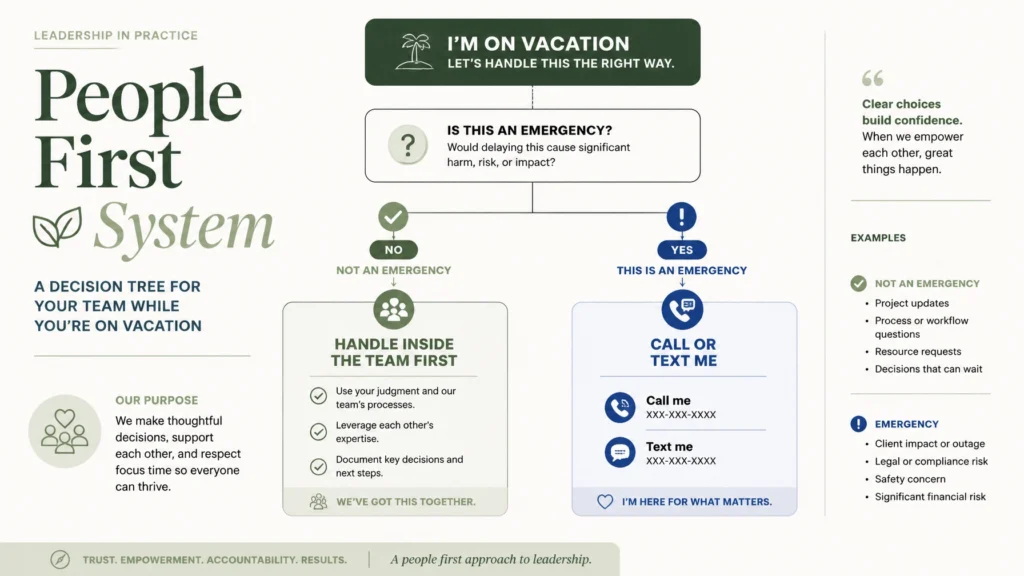
Define the emergency before your vacation starts
Most leaders say, “Text me if anything urgent comes up.”
This is where vacations turn into remote work.
Urgent cannot stay open to interpretation. Your team may define urgency differently than you do, especially if they are used to getting quick replies.
Try this framework.
Not an emergency:
- Routine approvals.
- Scheduling questions.
- Internal disagreements.
- Non urgent client requests.
- Minor mistakes.
- Anything able to wait 24 hours.
Handle inside the team first:
- Client dissatisfaction.
- Deadline risk.
- Tech issues with a workaround.
- Staffing gaps with internal coverage available.
- Team conflict needing a manager response.
Call or text me:
- Legal risk.
- Safety issue.
- Major client loss risk.
- Fraud concern.
- System outage with no workaround.
- Time sensitive revenue issue no one else can resolve.
Then make communication rules explicit.
- Internal messages are closed while you are away.
- Email is for non urgent updates only.
- Text is for defined emergencies.
- Calls are for immediate issues requiring a response now.
Boundaries work better when they are specific. A vague boundary creates guilt for the leader and confusion for the team.
Personal guardrails for the leader who keeps checking
Team boundaries matter. Personal boundaries matter just as much.
A cracked door is still an invitation to walk back in.
Delete work email and internal message apps from your phone for the week. Log out of work accounts before you leave. Turn off work notifications on every device. Give one trusted person a single emergency path. Leave your laptop at home if possible.
Add a reminder to your lock screen:
“If it is not an emergency, it can wait.”
Tell your travel partner or family member your rule so someone outside work can hold you accountable. Replace the refresh habit with something specific, such as a walk, coffee, a book, a swim or a conversation without your phone in your hand.
Checking in may feel responsible. Most of the time, it is anxiety with better branding.
Real rest requires a system, not just willpower.
What if you are worried the team cannot make it without you?
This may be the hardest part of the whole plan.
Your team might not be the first one to break the boundary. You might.
Not because you do not trust them at all. Not because they are incapable. More often, it happens because your brain has learned to stay on alert. You are used to being the backup plan, the quick answer, the final check and the person who notices what others miss.
So even after you set the out of office reply, name the owners, define the emergency rules and give people a plan, you may still feel the pull to check.
Notice where your own worry may pull you back in
Maybe a client issue is still sitting in the back of your mind. A deadline may feel too close for comfort. One team member’s hesitation from the last meeting might keep replaying. Before long, the thought shows up: “I’ll just look once.”
This is how the boundary starts to crack.
If this sounds familiar, do not shame yourself. Get specific.
Before you leave, write down the three situations you are most likely to worry about. Then check your plan against those exact situations.
Who owns each one?
What decision can they make without you?
Where will the update be documented?
What would make it a true emergency?
What can wait until you return?
This gives your brain something better than vague worry. It gives it proof of a plan.
You can also create a return list instead of a check in habit. When a worry pops up, write it down in a note called “When I get back.” Leave email closed, keep the team chat quiet, and resist searching for answers from the beach, the cabin, the hotel lobby or the passenger seat.
Write it down and come back to the present.
The goal is not to stop caring. The goal is to stop confusing care with constant access.
Your team cannot build confidence if you keep stepping in before they get the chance to use the clarity you created.
Let the plan work long enough to teach everyone something, including you.
What to do when someone breaks the boundary
Someone may still contact you for a non emergency.
Your response matters.
A quick answer teaches the team to keep reaching. Silence may feel uncomfortable, but immediate replies retrain people to depend on you.
Use a simple delayed response if needed:
“Thanks for sending this. This fits the plan we discussed before I left. Please work through it with the assigned owner and include it in the daily summary.”
After you return, address the pattern without blame.
“I noticed this came to me while I was out, but it did not meet our emergency rules. Walk me through what felt unclear so we can tighten the process for next time.”
This keeps accountability intact without shaming the person. It also gives you useful information. Maybe the boundary was unclear. Maybe authority was not strong enough. Someone may have lacked confidence, or the system may have had a gap.
People first leadership does not mean staying available all the time. It means building enough trust, clarity and communication for people to act without panic.
If your team needs stronger communication, cleaner ownership or more confident decision making, this is the kind of work we build through leadership and management coaching.
Use The Chaos to Clarity Reset before your next break
Vacation prep is not only about covering work.
It is also about noticing what your body and mind are carrying before you ever leave.
The Chaos to Clarity Reset is a personal audit for people who are carrying too much and need a place to start. It helps you name the pressure points, patterns, responsibilities and unclear expectations keeping you stuck in overwhelm, so you can begin building more clarity, better boundaries, stronger communication and simple systems.
Use it before your next vacation, long weekend, quiet afternoon or season where you realize too much is living in your head.
Download The Chaos to Clarity Reset
FAQ
How do I prepare my team before vacation?
Start by identifying every task, decision, approval or recurring question routed through you. Then assign clear owners, name backup contacts, document priorities and define what should count as an emergency. Preparing your team before vacation is less about doing extra work yourself and more about making ownership visible.
What should count as a real emergency while I am on vacation?
A real emergency usually includes legal risk, safety issues, major client loss risk, fraud, or a business critical problem with no internal workaround. Routine approvals, minor mistakes, internal disagreements and non urgent client requests should stay with the assigned owner or team.
How do I stop checking email and messages on vacation?
Remove easy access before the trip starts. Delete apps, turn off notifications, log out of accounts and give the team one clear emergency path. Replace the checking habit with a specific offline action. Logging off requires both a team plan and a personal guardrail.
What are good team accountability strategies before vacation?
Good team accountability strategies include naming primary and backup owners, clarifying decision rights, using one visible scoreboard and documenting who handles what. Accountability works best when people know what they own and where to go before escalating.
What should I do if vacation prep feels overwhelming?
Start with one pattern. Use The Chaos to Clarity Reset to name what you are carrying, then choose one area to clarify before you leave. Focus on the repeated problems first, not every possible issue.
What if my team still contacts me for non emergencies?
If your team contacts you for non emergencies, either the boundary was unclear or the system was not strong enough yet. Do not answer immediately. Redirect them to the assigned owner, then review the gap when you return. Every quick reply teaches people to keep bypassing the process.
Vacation should not depend on everything going perfectly
A real vacation does not mean nothing happens while you are gone.
It means every normal issue does not need you to solve it.
Your team may make decisions you would have made differently. A client question may take a little longer. A deadline may need adjustment. Someone may learn through a small mistake.
None of this means the plan failed.
It means leadership is shifting from access to clarity.
Workcation happens when everything still runs through you. Vacation becomes possible when people know what matters, who owns it, how to communicate and when to escalate.
Time off will not fix unclear systems by itself. Better clarity can make rest possible before you leave and more sustainable when you return.
Start with the download. Use The Chaos to Clarity Reset to name what you are carrying, then choose one place where clearer communication, ownership or a simple system would make leaving feel less daunting.
If your next trip already feels like remote work with a better view, we should talk. I work with leaders and teams to build people first systems, clearer communication and practical leadership structure so work can move without constant escalation.
Want to learn more about setting boundries and finding your clarity in the chaos, schedule a Clarity Call.
