

Focus Over Frenzy
The Problem: Founders get addicted to the dopamine hit of fixing crises, creating a growth ceiling.
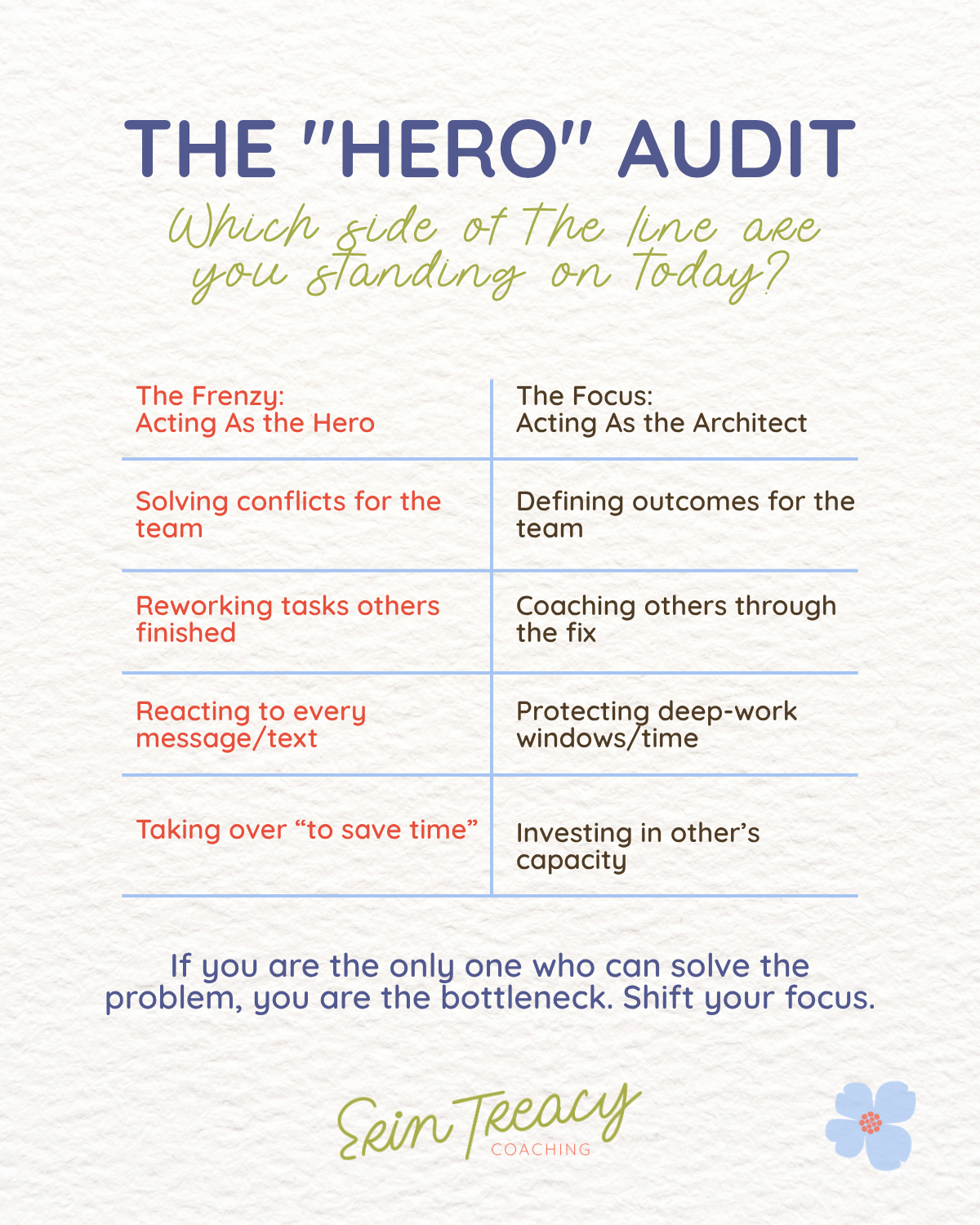
The Shift: Moving from Hero (Fixer) to Architect (System Builder).
The Tool: Use the Hero Audit to identify low-value tasks that should be delegated.
The Goal: Reclaim 10+ hours a week for high-level strategic planning.
The anatomy of a 14-hour day
It is 9 p.m. on a Tuesday. The house is finally quiet, but your mind is a loud hall of mirrors. You are sitting at the kitchen table, the glow of your laptop the only light in the room, finishing a proposal that should have been done three days ago.
Why are you still working?
You spent your morning at the job site because a sub-contractor did not show up. You spent your lunch hour fixing a billing error that your office manager could not quite figure out. Your afternoon was swallowed by a three-way call to settle a dispute between two employees that has been simmering for weeks.
By all traditional measures, you had a productive day. You were the hero. You saved the project, you saved the client, and you saved the peace.
Yet, as you stare at the cursor blinking on the screen, you feel a hollow sense of dread. The strategic work and the high-level planning required to navigate the shifting 2026 market remain untouched. You are trapped in a state of frenzy. Worse, you secretly believe your business only survives because you are the one holding every single thread.

How to spot the hero in the mirror
Heroism feels like virtue, but in leadership, it is often a vice. It is a subtle addiction to being needed. To shift from fixer to architect, you must first recognize the symptoms of the heroism addiction.
You might be acting as the hero if:
-
The forwarding loop: Your inbox is full of emails from your own team asking, “What should I do about this?” instead of “Here is what I did about this.”
-
The rescue mission: You find yourself saying, “It is just faster if I do it myself,” at least three times a week.
-
The emotional shield: You are the only one who handles difficult clients because you do not trust your staff to maintain the relationship.
-
The information vault: Every major decision must pass through you because you are the only one with the full picture.
When you act as the primary infrastructure of your business, you create a ceiling. You are not building a resilient company. You are building a dependency.
Clarity is the only currency in 2026
The current market does not reward the person who works the most hours. It rewards the person who possesses the most clarity.
Frenzy is often just camouflage for fear. We stay busy with low-level fires so we do not have to face the hard, quiet work of deciding what no longer serves the vision. Doing less is not a luxury. It is a defensive maneuver.
To lead through the fog of this year, you must stop being the hero and start being the architect.

An architect does not lay every brick. An architect ensures the blueprint is sound so the structure stands even when they walk away. When you step back, you give your team the room they need to step up.
The hero audit: A tactical self-assessment
Tomorrow, I want you to keep a tally. Every time you solve a problem someone else on your payroll is actually paid to solve, put a mark on a piece of paper. At the end of the day, look at the list and ask these three questions:
-
How many of those hero moments actually grew your revenue?
-
How many of them prevented your team from learning a necessary lesson?
-
What would happen if you simply said, “I trust you to handle this”?
Real takeaways for the busy founder
To move from hero to architect, you need these three shifts:
-
Audit your yes: If a task does not require your specific 500 dollar an hour skill set, it is a no. Guard your time like it is your most expensive asset because it is.
-
The 24-hour rule: When a team member brings you a non-emergency problem, wait 24 hours before offering the solution. Watch how often they solve it themselves.
-
Protect the white space: Block two hours on your Tuesday morning for architect time. No Slack. No email. No fires. Just the blueprint.
The next step
The shift from fixer to architect is the hardest identity change a founder will ever make. It feels like losing control, but it is actually the only way to gain focus and clarity.
Stop carrying the bricks. Start drafting the plans.
If you are ready to stop being the bottleneck and start being the architect of a business that runs without you always having to interveen, let’s connect.
FAQ: Frequently Asked Questions
Q: What is the difference between a hero and an architect in leadership?
A: A hero is a reactive leader who thrives on solving crises. An architect is a proactive leader who focuses on building systems and empowering their team to solve problems independently.
Q: How do I know if I am the bottleneck in my company?
A: Common signs include an overflowing inbox of how-to questions, a team that waits for your approval for every action, and the feeling that the business would stall if you took a week off.
Q: What is the first step to stop micromanaging?
A: Start with the 24-hour rule. By waiting one day to provide a solution to a non-emergency, you give your team the space to develop their own competence.
