

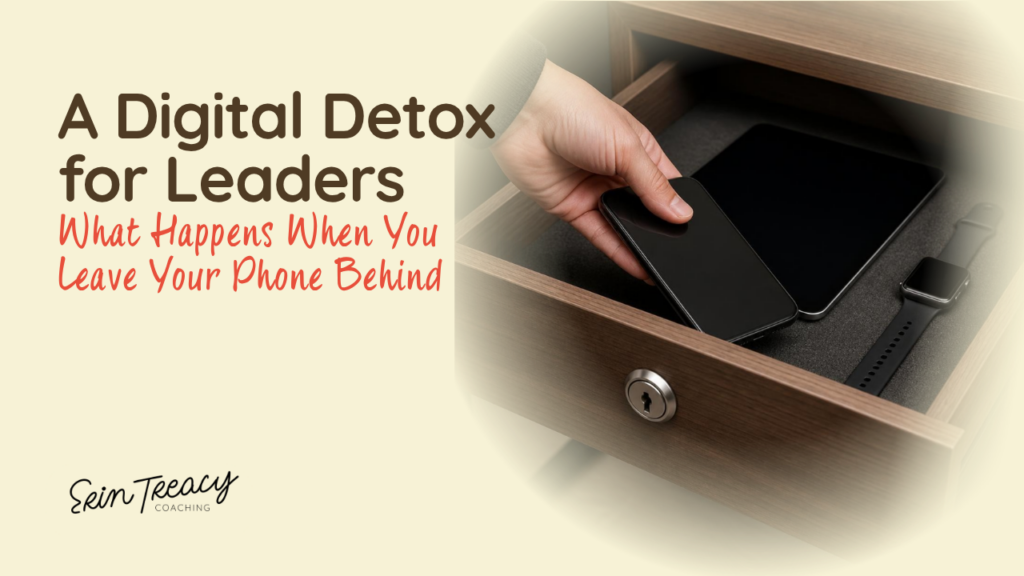
You walk into a meeting, reach for your phone to check the time, and it isn’t there. Maybe it’s still on your desk. Maybe it’s sitting in the car’s cup holder. You genuinely can’t remember which. This five second gap, before you even sit down, is where a digital detox for leaders actually starts, whether you asked for one or not.
Do you excuse yourself and go get it? Or do you sit down and spend the next hour half present, silently keeping score of who might be calling, who’s texting, and how many emails are stacking up unanswered. The horror.
Most people already know what happens next. You nod along. You miss the real point twice. Your body sits in the meeting while your attention stays parked somewhere between your desk and the parking lot, guarding a phone doing nothing at all right then.
I don’t own a smartwatch. I don’t own a watch at all. It isn’t a style choice. It’s a boundary. One more device buzzing on my wrist would pull me straight back into the same parked attention problem, and the person sitting across from me deserves better than half my focus.
Phone Addiction and Burnout, By the Numbers
New research says this reaction isn’t unusual. It’s the norm.
Pew Research Center surveyed nearly 10,000 U.S. adults this spring and found 53% say they spend too much time on their smartphone. Among adults under 30, the figure climbs to 70%, and 42% describe their phone use as almost constant. Adults 65 and older report far less strain, with only 25% saying the same.
Age also shapes what the habit costs. Adults under 30 are the only group where a majority, 62%, say their phone hurts their sleep. Nearly half say it hurts how productive they are. Adults 65 and older report a different story, with only 14% saying the same about sleep. The younger someone is, the more likely their phone is quietly working against them.
Here’s what matters most for leaders. Wanting to cut back and actually doing it are two different fights. 45% of adults say they’ve tried to reduce their phone use in the past year, but only about a quarter call the effort highly successful. Most describe it as only somewhat successful. Willpower alone rarely beats a device built to be irresistible.
This design isn’t an accident. A Georgetown University psychologist told Axios today’s wave of digital detoxes is partly a response to algorithms engineered to be as addictive as possible. Gen Z seems to understand this earlier than older generations do. In one recent survey, 47% of adults under 30 said they’re actively trying to cut back, compared with 32% of older adults. The generation raised most connected to their phones is now leading the effort to disconnect from them.
Why a Digital Detox for Leaders Beats Willpower Alone
You can’t out willpower a notification. Only one move works: remove the trigger before it gets a chance to pull you away.
I’ve written before about the real cost of a single interruption and the twenty seven minutes it can take to fully refocus once a ping pulls you away. Protecting your attention isn’t a luxury for leaders. It’s closer to a job requirement.
Think about the last time you were mid conversation with an employee, a customer, a coworker, your kid, your spouse, or a friend, and you stopped them because someone was texting you. You had to look, just to make sure it wasn’t something important.
Is the person in front of you not important? Is a Facebook notification really worth checking right now, while the person in front of you waits? What message are you sending them right then?
Burnout rarely arrives all at once. It builds through a hundred small interruptions a day, each one pulling you slightly out of the moment you were supposed to be in, and slightly out of the relationship you were supposed to be building. If you want a fuller picture of how this shows up in leaders specifically, I broke it down in Signs of Leadership Burnout.
A Digital Detox for Leaders You Can Try Tonight
This is the same principle behind an exercise I run in every burnout workshop I lead. Phones and smartwatches go on the floor, screens down, out of reach, so nobody can feel the buzz or see the light pop on. Watching a room full of confident, capable leaders flinch at losing the connection tells you everything about how tightly wired the habit really is.
You don’t need a room full of coworkers to test it yourself.
Pick one hour. Turn off notifications, don’t just silence them, actually turn them off. Put your phone somewhere you can’t see or feel it. A drawer, a bag, the floor. Notice what happens in your body during the first ten minutes. Most people describe a low hum of anxiety they didn’t know was there until it stopped.
This hum has a name. Researchers call it phone addiction. Whatever you call it, it’s worth naming, because you can’t fix what you refuse to see.
If a digital detox for leaders is something your team needs and hasn’t found yet, I’d like to hear about it. Book a time to talk and we’ll look at what’s actually going on and what might help
FAQ
Phone addiction describes the compulsive pull toward notifications, even when nothing urgent is happening. For leaders, this pull fragments focus throughout the day. The accumulated interruptions drain the same mental energy needed for good decisions, patience, and presence, which is exactly what leadership burnout looks like from the inside.
The anxiety is a learned response, not a personal weakness. Every notification trains the brain to expect a small reward, so removing the phone interrupts a pattern the nervous system has practiced for years. For most people, the discomfort fades within the first hour once the loop breaks.
Start with removal instead of restriction. Put the phone somewhere you can’t see or feel it, a drawer or another room, for one focused hour. Turning notifications off matters more than silencing them, since a blinking light can pull attention just as easily as a buzz.
A single hour is enough to notice a shift in focus. Pew Research found 45% of U.S. adults tried cutting back on phone use this year, though only about a quarter called it highly successful, which is why small, repeatable breaks tend to work better than one big attempt at willpower
