

When Rory McIlroy won the Masters, he talked about how present the crowd felt. More engaged. More locked in. More connected to the moment.
The reason is simple.
At Augusta, patrons cannot bring in cell phones or smart watches. The tournament removes one of the biggest barriers to attention before anyone ever steps onto the grounds.
That kind of focus is rare now.
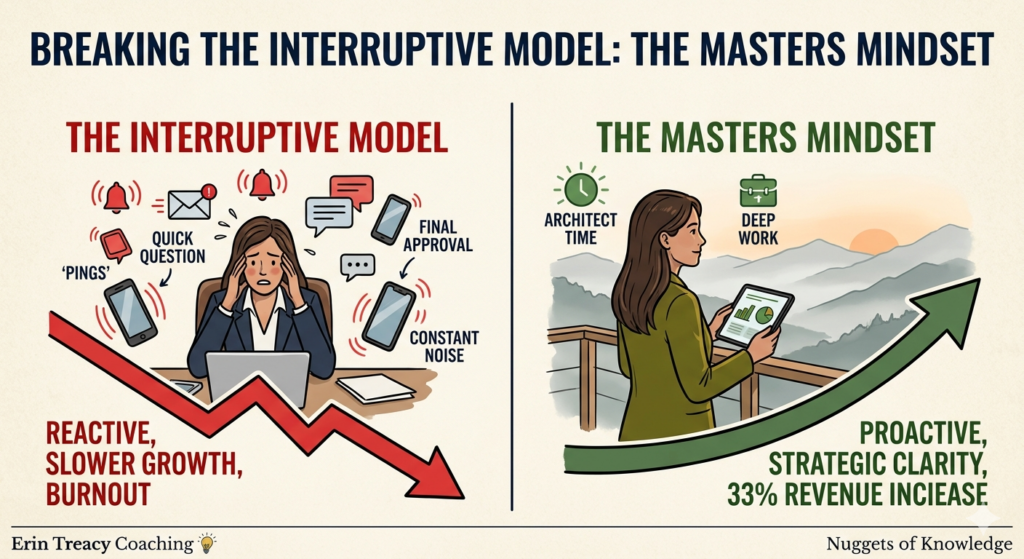
Most leaders begin the day in a flood of pings, quick questions, last minute approvals, and constant interruption. It does not happen because they lack discipline. It happens because the business gives everyone full access to their attention.
And when everyone can interrupt the leader, leadership becomes reactive.
The cost of constant access
A lot of business owners and leaders wear availability like a badge of honor. They pride themselves on being responsive, involved, and needed.
But being needed at every turn is not a growth strategy. It is often a bottleneck.
When every question comes back to you, decisions slow down. Your team waits. Work stacks up. You spend your day solving problems other people should be learning to solve.
Over time, the business begins to depend on your presence more than your vision.
That comes with a real cost. Leaders who delegate well create more room for higher-level thinking. Leaders who stay buried in every detail stay trapped in the weeds. Protected focus is not a luxury. It is part of how growth happens.

The shift from firefighter to architect
You cannot build the future of your business while spending all day putting out fires in the present.
Growth requires a different role.
It requires moving from firefighter to architect.
That shift starts with protected focus. Time on your calendar where you are not answering texts, replying to messages, or jumping into every small issue. Time reserved for thinking, planning, and making the decisions only you should make.
This is what I call the Augusta Rule.
Create space where interruption is not allowed.
Not because you do not care. Not because you are trying to be less available. Because your company needs more from you than instant answers. It needs vision, judgment, and structure.
Three ways to apply the Augusta Rule
1. Protect one strategic hour each day
Block sixty minutes on your calendar with no calls, no texts, no inbox, and no quick check-ins. This is not catch-up time. This is decision time. Use it for planning, problem solving, and work that actually moves the business forward.
2. Stop giving the full answer
When a team member brings you a problem, do not jump straight to the solution. Share the reasoning behind your thinking and ask for their recommendation. This builds judgment. It also starts to break the pattern where every answer has to come from you.
3. Find where work is waiting on you
Look at the projects on hold because they need your review, your signoff, or your final touch. Those slowdowns are not small. They point to the places where your business still depends too heavily on one person.
Usually, that person is the leader.
Real leadership is not constant availability
Many leaders think they need to stay reachable to stay effective.
But constant access often creates weaker teams, slower decisions, and less room for real leadership.
Your greatest value is not how quickly you respond to every issue. Your greatest value is how clearly you can see what matters next and build the conditions for better work to happen without your hand on every part of it.
You cannot do that when your attention belongs to everyone else.
Protected focus is not selfish. It is responsible.
It gives you the space to think. It gives your team the chance to grow. It gives your business a better shot at real momentum.
The leaders who grow are not always the ones doing the most.
Often, they are the ones willing to remove what keeps better thinking from happening in the first place.
So here is the question:
What is one interruption you need to remove this week so you can lead with more clarity?
If this idea hit home, share this post with another leader who needs more room to think, or reach out if you are ready to create better structure inside your business.
