Why Career Goals Fail and What Actually Works Instead

Why Career Goals Fail and What Actually Works Instead top of page Home About Types of Coaching Leadership & Management Coachin Performance & Productiv...

Erin Treacy

April 30, 2026

Intentions, habits, and identity-based growth for professionals

Every year begins with good intentions.

New planners. Fresh calendars. Career goals written with confidence.Be more focused. Communicate better. Lead more effectively. Move ahead professionally.

Then real workdays arrive.

Meetings stack up. Priorities collide. The to-do list grows while progress feels slower. By February, many goals fade quietly into the background.

This pattern is common and predictable.
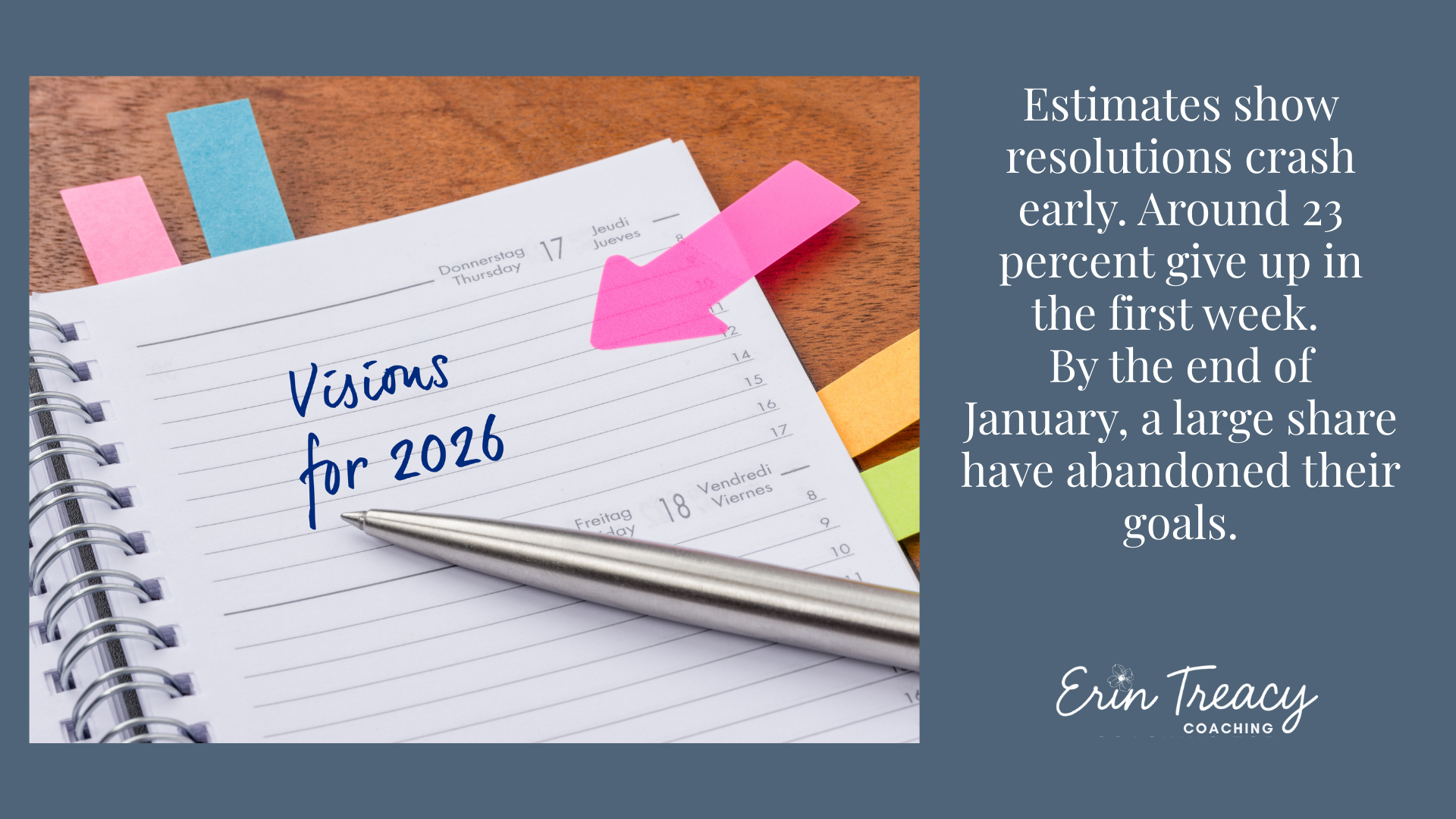
Most New Year’s resolutions fail early. Research shows around 23 percent of people give up in the first week, and by the end of January many goals are already abandoned. This isn't a motivation problem. It's a design problem. Task-based resolutions and to-do lists rely on will power instead of meanting. Sustainable career growth and professional development come from clear intentions, small habits, and identity-based change.

Research consistently shows fewer than 10 percent of people fully follow through on New Year’s resolutions, especially when goals rely only on motivation or task-based to-do lists. The issue is rarely effort or discipline. The issue is how goals are designed.

To-do lists focus on tasks. Sustainable career growth comes from meaning, habits, and identity.

The Problem With To-Do Lists in Achieving Career Goals

To-do lists answer one question.What needs to get done?

They rarely answer the question many professionals struggle with most.How do I want to show up in my role?

In professional development and leadership, tasks change constantly. Meetings get canceled. Deadlines shift. New priorities appear mid-day. When growth goals live only on a task list, progress depends on perfect conditions.

A to-do list might say, “Speak up more in meetings.

An intention sounds like, “I want my voice to add value and clarity.

A task says, “Delegate more.

An intention says, “I want to build trust and ownership on my team.

To-do lists chase productivity. Intentions guide behavior across real workdays.

Why Motivation Fades at Work and Habits Matter More

Motivation peaks early in the year. Pressure and pace wear it down quickly.

Habits support long-term professional growth when motivation disappears.

Small habits fit into real workdays. They do not require extra time or ideal conditions. They quietly support progress in communication, leadership, and focus.

Instead of: “I will become a better leader this year.

Try: “Before meetings, I will clarify my main message.”

Instead of: “I will manage my time better.

Try: “At the end of each day, I will reset tomorrow’s top priority.

These habits feel small by design. Small actions repeat more easily. Repetition builds confidence.

Confidence builds credibility at work.
To-do lists help to manage tasks. Professional development works best when goals are rooted in meaning, supported by small habits, and reinforced through identity. When people focus on how they want to show up at work, progress lasts longer than any checklist. Growth is not about doing more. It's about doing what matters consistently.

Identity-Based Growth Shapes Long-Term Careers

Most career goals focus on outcomes. Promotions. Titles. Recognition.

Identity-based growth shapes long-term careers more effectively.

A helpful question sounds simple.Who do I want to be at work?

Someone who communicates clearly under pressure.Someone who stays steady during change.Someone others trust to follow through.

Each small habit becomes evidence of identity. Preparing before conversations. Listening fully. Pausing before reacting.

Over time, these behaviors shape reputation and confidence. Growth feels less forced and more natural. Careers rarely change through one dramatic move. They evolve through consistent, intentional choices.

Why Small Changes Build Real Professional Success

Big goals feel inspiring. Small changes feel manageable.

Manageable wins build momentum. Momentum builds belief.

Small changes at work:

• Reduce overwhelm

• Lower burnout risk

• Fit into busy schedules

• Build trust with yourself.

Missing a day does not derail progress. You reset and continue. The same principle applies to professional growth and leadership development. Steady progress outperforms perfect plans.

Sustainable Career Growth

Sustainable career growth rarely comes from dramatic goals or perfect planning systems. It comes from clear intentions, small repeatable habits, and an identity rooted in how you want to work and lead.

This approach supports focus, confidence, and resilience across changing roles and responsibilities.

You Do Not Have to Wait

It may be the start of a new year. It does not have to be a start date.

Intentions work any day. After a hard week. After a challenging meeting. After realizing something needs to change.

You do not need a new planner or system. You need clarity around what matters and one habit small enough to keep.

Choose an intention with meaning. Build one small habit.Let identity evolve over time.

Professional growth does not come from doing more. It comes from doing what matters, consistently.

One step at a time builds habits that last.

You do not have to figure this out alone.

A clarity call is a focused conversation to help you name what matters and decide what comes next.

Schedule your clarity call when you are ready.

Frequently Asked Questions

If your day already feels out of control before your feet hit the floor in the morning, you are likely the kind of person I work with.

You may be a business owner, leader, manager, or professional carrying too much, fixing too much, and feeling like too much depends on you. Erin Treacy Coaching is for people who believe in a people first way of leading and living, and who want stronger communication, better accountability, healthier systems, and a more productive and meaningful life.

This work is for people who are tired of constant reaction and ready for a better way forward.

Coaching is a strong fit when work feels heavier than it should and you know something has to change. Most people reach out when they are tired of carrying too much, fixing the same problems over and over, or feeling like the business cannot move without them.

You may be the bottleneck in your organization. Your team may not be showing up the way you need them to. Performance may feel inconsistent. Communication may break down too often. You may spend more time reacting than leading. By the time the day starts, you already feel behind.

Coaching creates space to slow the frenzy, see what is really driving the problem, and build a better way forward. Sometimes the issue is not the people. It is how the work, expectations, and communication are set up around them. Coaching gives you a clearer view of what is happening, what needs to change, and how to move from constant reaction to steadier leadership.

Servant leadership focuses on how a leader shows up for the people around them. It is about listening, supporting, building trust, and leading with care.

People first coaching includes those values, but it goes further. It also looks at how the business or team is set up for people to succeed. That means roles, expectations, communication, training, accountability, and everyday systems.

In other words, servant leadership often focuses on the heart of the leader. People first coaching looks at both the leader and the environment around the team. A leader can care deeply about people and still have a workplace full of confusion, inconsistency, and stress. People first coaching works to align leadership, structure, and culture so people can perform well without everything depending on one person holding it all together.

Both. Erin works with individuals in one to one coaching and also supports teams through workshops, leadership development, and workplace training.
Yes. Many workplace problems are not caused by a lack of effort. They come from unclear expectations, weak communication, and pressure people have not been taught to manage well. Coaching focuses on building the habits and conversations that create steadier performance and stronger trust.
Yes. Coaching can support people who feel stretched thin, overwhelmed, or stuck in constant reaction mode. The goal is not to push harder. The goal is to create clarity, better decisions, stronger communication, and work habits people can sustain.

A clarity conversation is a safe place to talk honestly about what the frenzy looks like in your work or life right now. This is not a sales call. It is a starting point.

We slow things down, look at what feels out of control, and begin to understand what is really driving the stress, pressure, or frustration. You do not need to come in with polished answers.

The goal is clarity, understanding, and a better sense of what kind of support makes sense from here.

About Erin Treacy

Erin Treacy is a leadership coach and consultant specializing in people-first approaches to professional development. With over 15 years of experience, she helps leaders and organizations build cultures where people thrive and businesses succeed.

If you enjoy the content, we’d love for you to share it with a friend!

INSIGHT

Recent Posts

Overfunctioning: The Weight You Don’t Notice Until You Set It Down

Overfunctioning creeps up slowly. Recognize the invisible weight of carrying too much and find small

Parenting a Young Adult: College Move In Advice for Parents

College move in brings excitement, pride and a new parenting role. Practical advice on letting

Busy Is the New Fine: Why Leading Your Life Is Actually Just Adulting

Leadership is adulting. We fill our calendars with supposed-to-dos to prove we're important, but a