


There is a moment many high performing women reach, though few say it out loud.
They begin to wonder if something is wrong with them.
They used to think faster.
Decide faster.
See solutions faster.
Now everything feels heavier.
Simple decisions take longer.
Problems feel bigger than they should.
Clarity feels just out of reach.
They do not recognize themselves.
So they assume the problem is them.
It is not.
The problem is not your ability.
The problem is constant mental occupation.
You have lost your space to think.
Leadership burnout does not destroy clarity. It buries it.
Most leaders today do not have a capability problem. They have a capacity problem. Leadership burnout develops when responsibility continues to increase but recovery never happens.
Their brain never turns off.
Work decisions.
Family responsibilities.
Messages waiting for replies.
Problems waiting for solutions.
Even in quiet moments, the mind stays active.
There is no recovery.
There is no reset.
And without reset, clarity cannot surface.
Your brain was never designed to operate at full output without pause.
Clarity requires space.
Not more effort.
Not more discipline.
Space.
The hidden cost of leadership burnout and constant responsibility
Women carrying leadership roles at work and responsibility at home rarely get true mental rest.
Even when they stop working, they are still thinking.
Anticipating.
Planning.
Remembering.
Holding everything together.
This constant state creates mental fog.
Not because they are weak.
Because they have been strong for too long without interruption.
Eventually, the nervous system protects itself by slowing things down.
This is not failure.
This is biology.
Why pushing harder makes leadership burnout worse
Most high performers respond to this fog the only way they know how.
They push harder.
They work longer.
They try to become more efficient.
They attempt to outwork the problem.
This deepens the cycle.
Clarity does not come from pressure.
It comes from recovery.
Some of the clearest thinking does not happen while working.
It happens while walking.
Sitting quietly.
Stepping away long enough for the nervous system to settle.
This is why your best ideas often appear in the shower, driving, or outside.
The brain finally has space.
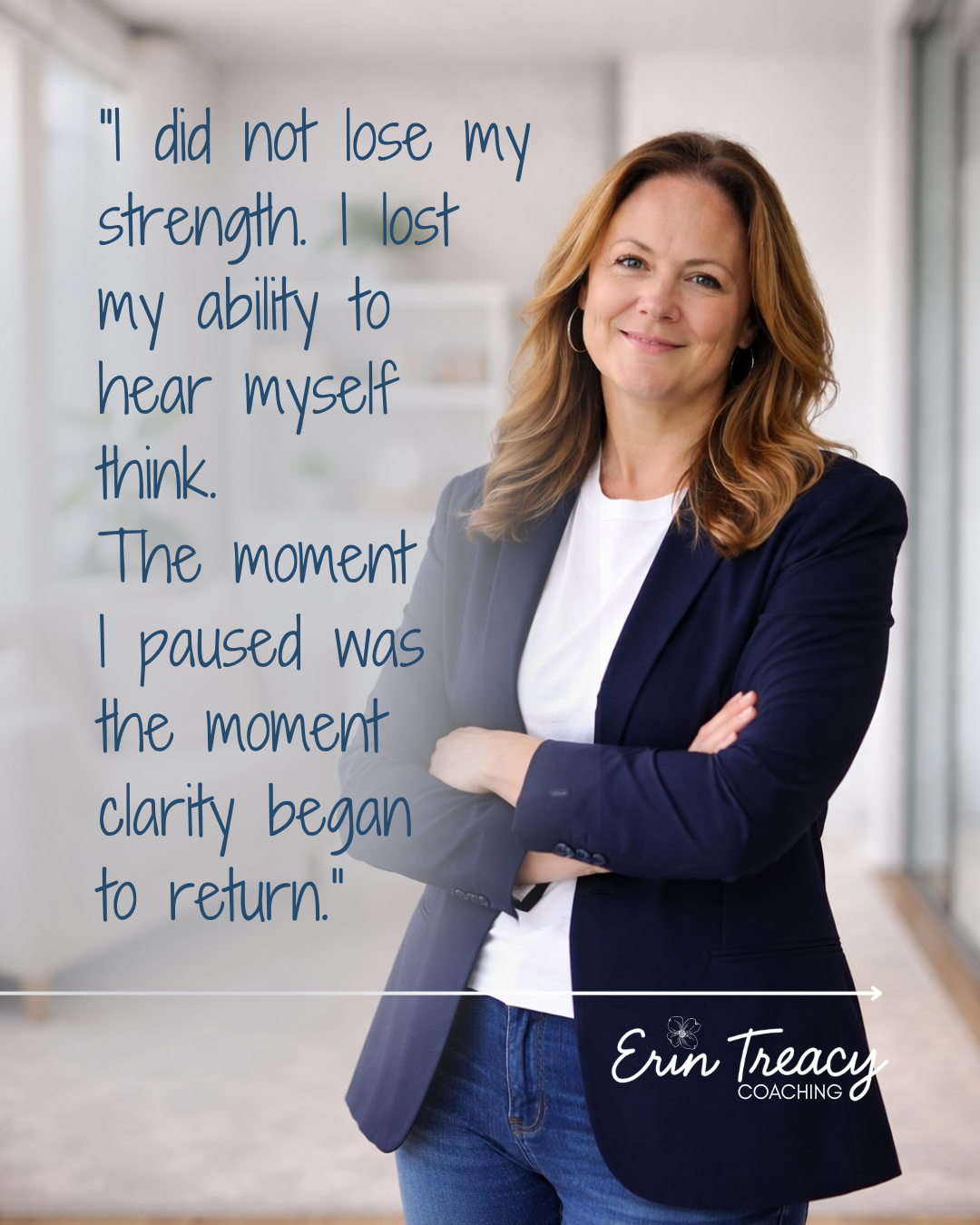
Leadership burnout rarely comes from weakness. It comes from prolonged responsibility without space to recover. The strongest leaders are often the most vulnerable because they are the ones carrying the most.
The pause most leaders avoid
Pausing feels uncomfortable for people used to carrying responsibility.
It feels unproductive.
Irresponsible.
Self indulgent.
But the pause is where leadership strengthens.
When you pause, you begin to see:
What actually matters.
What does not.
What is yours to carry.
What is not.
Without pause, everything feels equally urgent.
With pause, priorities become clear.
This is not about doing less. It is about leading differently.
Strong leadership is not built on constant motion.
It is built on clarity.
Clarity allows you to:
Make better decisions.
Communicate more effectively.
Support your team more confidently.
Preserve your own energy.
Your effectiveness does not come from how much you carry.
It comes from how clearly you see.
The simplest place to begin
You do not need a dramatic life change.
You need small, intentional space.
Five minutes without your phone.
A short walk without input.
A moment where nothing is required of you.
At first, this may feel uncomfortable.
That is normal.
Your nervous system is learning safety again.
Over time, clarity returns.
Not because you became someone new.
Because you gave yourself the space to become yourself again.
How leaders recover from leadership burnout
Recovery begins with space.
Not space to quit. Space to think.
Leadership clarity returns when the nervous system no longer operates in constant survival mode.
Small pauses restore decision making, emotional stability, and confidence.
Final thought
You are not losing your edge. Leadership burnout creates the illusion of decline, when the real issue is lack of recovery.
You are operating without recovery.
Clarity has not left you.
It is waiting for space to return.
