

The Frustrating AI Loop Every Customer Knows
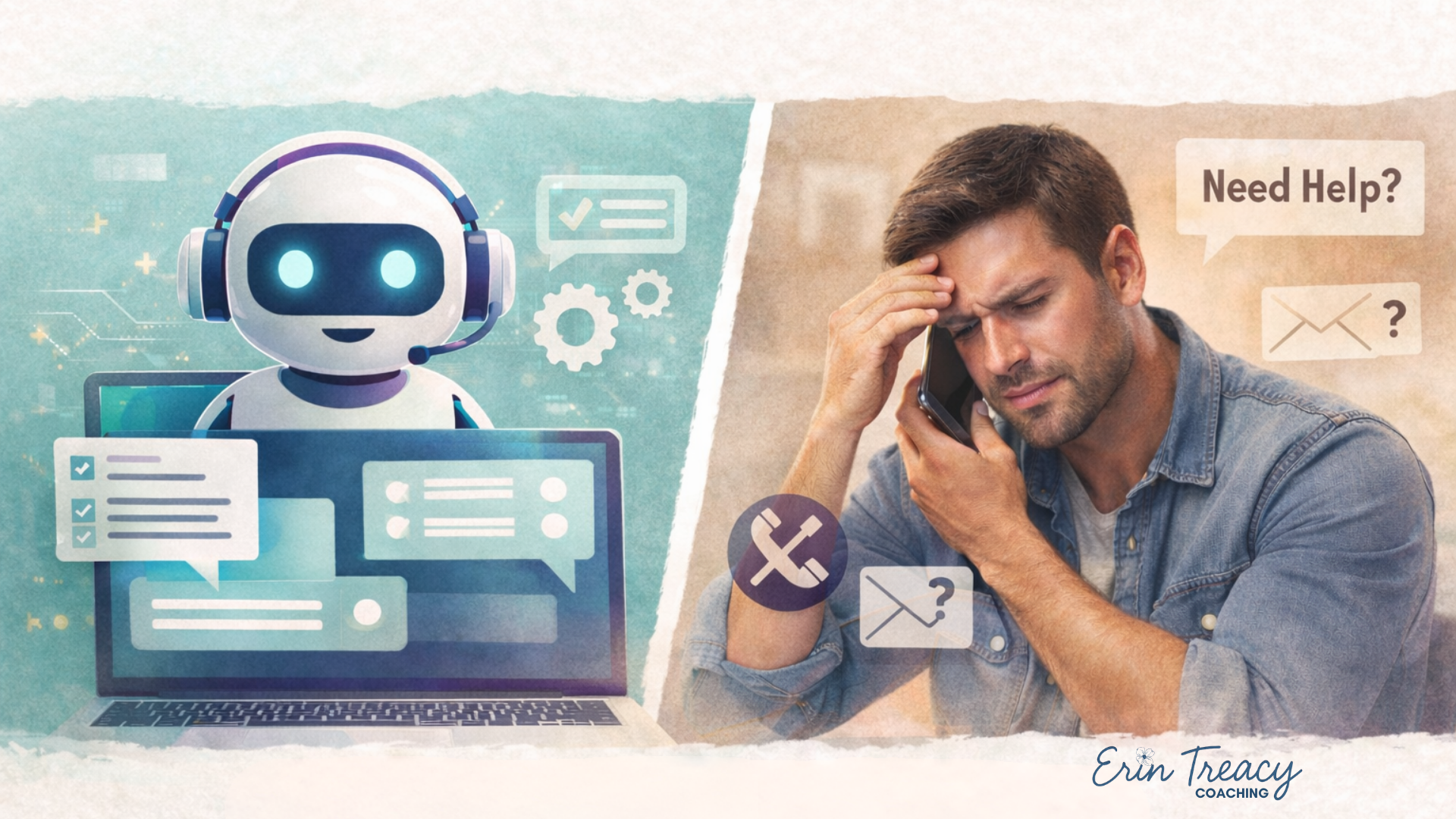
You type your question into the AI chatbot.
It asks one question. Maybe two.
Then it gives you a few link options. You click one. It does not answer your question. You go back and try again. This time you click a different option. It sends you to the same page in a slightly different format.
Now you are frustrated.
You start scanning the page for a “contact us” link. One takes you back to the chatbot. Another says “learn more” and directs you to the same resource page. If you are lucky, you find a generic email address with no clear expectation of when someone might respond.
Some companies have removed phone numbers entirely.
By the time you finally reach a person, if you reach one at all, your patience is gone.
We have all lived this.
The danger for business owners is this. Customers do not always leave angry reviews. Many simply stop doing business with you.
Why AI in Customer Service Can Quietly Increase Churn
AI in customer service can be powerful. It can reduce repetitive work. It can shorten response times. It can help manage employee burnout.
But when automation replaces clarity or access, it creates a loyalty gap.
Resolution is not the same as relationship.
A customer’s issue can be solved technically, yet the emotional experience can still feel dismissive or exhausting.
Customers may not complain publicly. They may not ask to speak to a manager. They may simply disengage.
Handled customers rarely refer friends, neighbors, or family.
Frustrated customers often tell 12 to 15 people about a negative experience.
For service based and smaller businesses, growth depends on retention just as much as referrals. Quiet churn is far more dangerous than visible complaints.
What the Data Says About Customer Experience and Loyalty
The numbers reinforce what customers are already feeling.
More than 80 percent of customers say the experience a company provides is as important as its products or services.
Nearly 70 percent say they are more likely to spend more with companies that deliver consistent positive experiences.
Up to 65 percent of customers have stopped doing business with a brand after repeated poor service experiences.
Customers do not separate technology from experience. If AI makes it harder to get help, they associate that frustration with your brand.
And here is something many businesses overlook.
You may not see a spike in bad reviews. Instead, your total number of reviews each month may decline.
Fewer referrals. Less engagement. Fewer repeat purchases.
Customers often ghost instead of complain.
If review volume is down while ratings stay stable, that may be an early warning sign of frustration or disengagement.
Why Mid Level Managers Feel the Pressure First
Owners look at dashboards.
Response times improve.
Tickets close faster.
Labor costs stabilize.
Managers look at conversations.
Customers sound more frustrated.
Frontline teams absorb more emotional energy.
Escalations feel sharper.
Mid level managers sit between efficiency goals and emotional reality. They are living in the middle of AI helping operationally while still managing customers who have already gone through the automation loop.
If leadership celebrates efficiency without acknowledging friction, managers carry the weight.
AI should reduce employee burnout. It should not shift that burnout to customers.
How to Use AI Without Damaging Customer Trust
The solution is not to eliminate automation.
The solution is to design it with a customer first approach.
Separate Repetitive Tasks From Emotional Moments
AI works well for low emotion, repetitive requests.
Password resets.
Order tracking.
Appointment confirmations.
Basic FAQs.
These uses protect employee capacity and save time.
But when emotion rises, automation should step back.
If a customer is confused, upset, anxious, or facing a high stakes issue, human access becomes a trust signal.
Design your workflow around emotional intensity, not just cost reduction.
Make Human Access Visible and Easy
Do not bury the phone number.
Do not hide the live chat option.
Do not make customers prove they deserve a person.
Even knowing a human is available increases trust.
Clear options such as “Talk to a person” or “Request a call back” reduce anxiety immediately.
When customers feel trapped, frustration escalates. When they feel control, trust strengthens.
Measure Relationship Health, Not Just Handle Time
If you only measure handle time, deflection rate, and cost per interaction, you are measuring operational efficiency.
Add metrics that reflect customer trust.
Track repeat issues after AI interaction.
Monitor customer effort scores.
Watch review volume month over month.
Measure referral and retention trends.
If customers are interacting less, referring less, or quietly disappearing, your automation strategy may need adjustment.
Audit Your Customer Experience From the Outside In
Walk through your system as if you are new.
Does the language assume insider knowledge?
Is it clear how to reach a person?
How many failed attempts occur before escalation?
What makes sense to you and your team may not make sense to customers with different levels of technical understanding.
Your workflow must serve both your employees and your customers.
Support Managers Living in the Middle
Managers need authority to escalate quickly. They need a voice in refining AI systems. They need space to report friction without being told the numbers look fine.
Invite their insight. Adjust based on patterns they see.
When managers feel supported, they protect both employee morale and customer experience more effectively.
The Leadership Advantage in an AI Driven World
Winning with AI does not mean cutting off phone lines or making it nearly impossible to reach a human.
It means integrating automation with emotional intelligence.
It means protecting employee capacity without creating customer burnout.
It means understanding that growth depends on retention and referrals, not just faster ticket closure.
AI is a powerful tool.
But trust is the growth strategy.
If you are a business owner, evaluate where efficiency may be quietly eroding loyalty.
If you are a manager, pay attention to patterns of frustration before churn appears in a report.
Customers will not always tell you when they are leaving.
Your systems will either invite loyalty or slowly push it away.
In an AI driven world, the leaders who win are the ones who protect the human connection.
Audit Your AI Strategy Before Churn Shows Up
If you are using AI in customer service, do not wait for negative reviews or declining revenue to tell you something is off.
Most customers do not complain publicly. Many simply disengage.
Use this Trust & Retention Checklist to evaluate whether your automation protects loyalty, supports your managers, and strengthens long term growth.
This is not about removing AI. It is about using it wisely.
If you would like help reviewing your results or redesigning your AI workflow, schedule a conversation.
